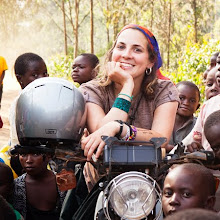
Sunday morning I’m rocked into the world by the smooth sounds of an Italian symphony orchestra. I can’t separate myself from dreaming for a while; the sounds of string harmonies tie my dreams to reality and the two worlds are able to communicate with the music acting as translator. I wake up when a male’s voice becomes another layer over the smooth water sounds of the strings and I realize that the music is in fact real. On Sunday mornings, Conchetta and Father Giovani play opera music or soft symphonies from large black loud-speakers. Starting at 6 a.m., the music floats over the village to help ease everyone through the transition from dreaming to life.
In the dining room, most everyone is already awake. A thermos of golden espresso is waiting alongside the remaining Kit-Kats, some handmade cheese, and gradually aging bread.
-Chief, says Dusan walking in from the front porch. Good morning.
-Good morning, I respond as I pour Conchetta’s magical, smooth black coffee into a mug.
There is nothing like fresh Italian espresso in the morning in the middle of Congo.
-Are C—and the others already setting up? I ask.
-I don’t know. I am thinking yes but I cannot think too early in the morning. You know this.
C—and his team are going to have a photo shoot in front of a green screen all day.
-I think I’m going to go check out the church for a little, I say.
I finish my coffee and then walk down the dirt road to a small brick building with colorfully dressed people covering the grass outside. I sit down next to an elderly woman who smiles at me. Nobody can hear anything that’s happening inside the church, yet everyone is sitting quietly as if receiving their own private mass and I’m the only one who can’t hear it.
-Maman ,says the woman turning to me. Give me money.
The woman puts the back of her left hand in the palm of her right and slides her fingers towards me repeatedly. It’s a common gesture and one that’s necessary to ignore unless I want to go broke or murder someone.
-No, I’m sorry, I say in French.
I stand up and leave the church, since I’m not included in the sermon anyway. Back at the house the music is still blasting but it has switched from soft symphony to children’s music. In front of my room there are about 20 children dancing around to the music. It’s quickly apparent which song is their favorite, and I think Conchetta must be watching since the song plays three times more often than the others. As soon as the first notes start to play all of the kids jump into action; right hand to forehead and left hand to back, then switch, shake booty and shuffle around. They look like rhythmic, and happy little worms.
In the jungle the miiiiighty jungle, the liooon sleeps toniiiight. In the jungle the mighty jungle the lion sleeps toniiiiiight.
A-weeeeeeeeeeeeeeeeeeeeeeeeeeeeeeeeee—a-wiimmmbaaa- weeeeeehhhh.
During the chorus all of the children start howling along with the song. I let one of them show me how to do the hand-to-forehead-rump-and-shake-then-switch dance and all of the kids laugh but keep dancing.
Hush my darling, be still my darling the lion sleeps tonight.
I look past the little crowd of laughter and movement and notice someone leaning against a banana tree on the far right side of the compound. He is wearing army green, black boots, and has an AK-47 slung over his shoulder. He’s leaning with one arm up against the banana tree, watching the children without seeming to really see them. I look on the other side of the compound and notice another AK-47 in green. The children either haven’t noticed or simply don’t care.
-The Mai-Mai have started to arrive, says Aubrey walking up from behind me.
-Yes, I was just noticing. Are you guys ready to get started?
-Almost. I think C—still has some stuff to do.
-Has he already set up the photo area?
-He’s working on it right now on the porch.
I say good bye to the kids with a quick worm gyration and walk around the house where there is a fairly large wooden porch jutting off of the house. C—has spread a green cloth on the far end of the porch and is arranging different sized lights that look like fancy umbrellas. I look towards the church and notice people starting to flow out.
-It looks like church is finished C---.
-Okay, thanks, I’m almost ready. Nelson and Aubrey will be selecting people as they come out.
C—has a cigarette hanging from his lips that wobbles as he speaks. Within only a few minutes the grass area around the porch is cluttered with human beings. As the number of people increases, so does the number of Mai-Mai. They stand mostly in a clump around the two Colonels who are sitting in wicker chairs. A few stick their fingers in the monkey cage, with their machine guns swinging in the air behind them. A young guy with short braids and colorful beads throughout is carrying a large rocket-propelled grenaden(RPG). Except for the Colonels, all of the young men are carrying at least one weapon.
I smile at the braided young man carrying the RPG and he nods at me and smiles back. Two of the young men carrying AK-47s turn and laugh at each other as one of the monkeys in the cage munches on some green weeds. Even though their carelessly held weapons often point at my chest and face, I feel completely at ease with them. I realize now why seeing the boys the other day seemed so normal; because they are normal. Army clothes and deadly weapons don’t make a boy a man or a monster. They are people, and once again, all of my preconceived judgments and ideas about things in Congo deflate completely. No, there shouldn’t be boys taught to kill but the reality of everything is much more complex than a simple right or wrong judgment.
C—invites some of the Mai-Mai onto the porch and begins arranging them; he molds their weapons and body positions as the villagers look on.
-There are two FDLR here, mutters Jay from behind Dusan.
He says it quietly and makes sure not to move his lips.
FDLR are a Rwandan rebel group that originated after the Rwandan genocide. They are composed primarily of ex-genocidaires and Rwandan refugees.
-Don’t look, he barks as Dusan begins to turn around.
-There is one next to the empty chair behind me, and one by the monkey cage, Jay continues as if practicing ventriloquism.
Everybody within hearing distance slowly scratches their cheek with their shoulder or stretches inconspicuously. The two men Jay is referencing look exactly like the other armed men in the yard.
-How can you tell? I ask.
-FDLR always carry two weapons. And I spoke with them and if you talk to someone you can know immediately.
-Why are they here? Is that a problem?
-No, it is not problem. Colonel S. invited them. FDLR gave warning that if we extracted anyone they would retaliate. Colonel S. told them to send people to make sure that we are not doing anything funny just taking pictures.
-Small chief, says Dusan. I think you must to arrange the things with Colonel S. for your dick-cutting project.
-Okay, I’m ready, I say.
Dusan motions to Colonel S. who quickly walks over to me. We step off the porch and walk a few feet away from the crowd.
-So, I was thinking I can just talk to your guys as they finish taking their pictures, I say in French.
-Okay. That sounds like a good idea, he says.
-Also, you told me you wanted me to speak with the head of some civilian council, correct?
-Yes, the Mwami-King. I think it is important you speak with him. The civilians need to be educated as well and they often are doing this raping and blaming it on Mai-Mai. The Mwami, for example, he will take a wife as young as this girl. He will take several wives of that age.
Colonel S. points to a little girl of about five years old hugging my leg.
-Really? I didn’t know that.
-Yes. It’s not good. You need to speak also with them so that they can know that this is not okay.
-Okay, I’m not sure when we’ll be able to but I will make-sure to make that part of my plan.
I’m also not sure how I’m going to combat culturally ingrained values and convince a village King that he shouldn’t marry a five year old. We finish speaking and Colonel S. walks onto the porch where he is similarly molded and posed. I grab my pamphlets. There are three pages, two with basic information about various sexually transmitted infections/HIV/AIDS and the Geneva Conventions. One page has an image of a very ill man and an image of infected genitalia. As these men have been living in the bush with almost no access to anything, the information I’m giving is basic but most likely new. It’s a bit crude, but still informative and just the beginning.
I walk over to the monkey cage when C—finishes taking their pictures. Rather than just one at a time coming, all 14 of the Mayi-Mayi and both of the FDLR soldiers follow me. Jay has agreed to translate for me and he and I stand in the middle of a messy half-circle. I hand out the papers to each person, and every individual reaches forward eagerly. One of the FDLR rebels reaches over the shoulder of a Mai-Mai a bit over-zealously and knocks the Mai-Mai guy forward a little. Neither seems to notice.
-Hello, my name is Amy, I begin. I’m here to talk to you about sexual violence, but also to just give you information related to this. I know that many times you are accused for things that you do not do, and by speaking with me you can show to others that you are not the ones doing this and that you want to suppress this type of behavior.
Jay translates and the rebels all watch me silently.
-This information is just basic information about sexually transmitted infections as well as the Geneva conventions, to show you what the consequences can be from sexual violence, on the part of the man.
One of the soldiers says something in rapid Swahili.
-He says they are not allowed to do this raping thing.
-Yes, I know this. I am not saying they are doing this or not, I’m simply trying to give them information about it. And I know that the purpose of Mai-Mai is to protect the communities. So if you will be open to working with me more, you can not only show that it is not you who are doing these things, but you can even become like teachers in your communities. That way if you know civilians who are confused about this or thinking it is okay to rape, then you can act as teachers and show them that it is very bad to rape. And as Mayi-Mayi, you are particularly good for this because women are such an important part of the community and you can further help protect your communities by learning about this and teaching others that sexual violence is very bad.
I speak some more about the information on the papers and the Mai-Mai stand patiently, listening and looking at the pages.
-I look forward to working with you more in the future, and thank you for speaking with me today.
I nod at them and smile and Jay and I turn to walk away.
-Merci, I hear several voices say behind me.
I’m exhilarated. They listened, they were interested. They even said thank you. And I have the go-ahead to keep working with them, which was the primary purpose of this initial visit. And even FDLR elements now have some of the papers and will no doubt bring them back to their camps. The papers do not accuse anyone, they simply include information. Education is a tool, and hopefully I’ll soon be standing in a crowd of FDLR with a Mai-Mai monitor or two.
The rest of the day consists of posing. The Mai-Mai, FDLR, and villagers all watch with the same interest and amusement. I’m even asked to step in for a few photos wearing head to toe African pagne. After a few hours the Mai-Mai’s patience is clearly starting to run out and Dusan has to inform C—that they need to leave. C— waves them off and keeps taking pictures of the villagers. He asks each one what their dreams are: a radio, cars, an education, a husband, hair like a muzungu girl, an angel as a wife. For dinner we eat Mediterranean salad complete with a type of coos-coos and olives.
Of all of the things I imagined about the bush, not one single thing was correct.
Tuesday, June 21, 2011


Wednesday, June 15, 2011
The Colonels
We gather ourselves and our things, including $50,000 worth of camera equipment, at one of the MONUSCO bases on Lake Kivu. C—explains while we eat omelets in the luxurious MONUSCO restaurant that he’s doing several things. He runs the UN Television station in Goma and is making a series on DDR/RR, Dusan’s section. He wants it to be hard-hitting, and show United Nations whistle blowers and decision makers in New York that “they don’t know what the fuck Congo is.”
C—is accompanied by two other Americans; Aubrey, a tall, wavy-haired doctorate student, and Nelson, a fairly quiet and freckled film maker who has a large black camera constantly glued to his hand.
-So, you’re sure that security is good enough, asks C—when he finishes explaining his project. I can’t simply replace this level of equipment.
-Yes, yes. Responds Dusan. Not any any problem. You can to ask Amy, she was there. We Arranged The Things with The Guy and this is sure. Absolutely sure. Right Amy?
The conversation with The Guy did end in the agreement of arranged security but it seems as if Dusan is doubting his own appraisal of the agreement.
-Definitely. I respond. He said he’ll arrange everything.
I don’t really trust my own appraisal either, but The Guy seemed straight forward and even a little kind.
-And aside from equipment, we are needing to take special care of the ladies, says Dusan, turning to Aubrey.
He has a glint in his eye that I recognize but I know she won’t be prepared for.
-I am thinking this is good thing you are coming, Aubrey. Because in this way, Amy won’t have to be only one raped. You can split it.
Dusan laughs, and I put my face in my hands. Aubrey looks shocked for a moment but quickly recovers and chuckles along with Dusan.
-Wow. Well, I guess it’s a good thing I’m coming, Aubrey retorts.
-No, I am not meaning this, says Dusan. I am just liking to confusing the things. If you think I am worst person in the world, then when I’m polite you will think I am extremely polite. And I am Croatian, and I am Dusan. So I am not often polite.
-Okay, well now I know, says Aubrey.
When we finish our omelets, half of the table smokes 3-4 cigarettes, and Dusan has rebuked Aubrey for speaking in a man’s presence before exploding in laughter, we move into the bright sunshine and climb into the shiny white vehicles. We drive several hours along the route Dusan and I just travelled to Kirumba, where there is a parish with rooms for only $10.00 a night. We stop at a local restaurant and eat salted tilapia fish, fries, sombe, and listen to Dusan explain the nuances of Serbia, Croatia, and Bosnia.
The next day we set out for Muhanga. On the way we stop at the Indian battalion in Kirumba, where three men were recently killed by Mai-Mai.
-These Indian soldiers are not soldiers, explains Dusan.
He and C—seem to agree on this point and they discussed it at length before we left even Goma.
-They are paid much better in UN than in India, he continues. But when they are here, I am telling you, they are doing everything they possibly can to do absolutely nothing. We are to stop here and to telling them that we are to go to Muhanga and if we need help they are to come. This is stupidity, I’m telling you. You see these cars their country sends? They can’t to drive more than 10 kilometers an hour. And no possibility they are to make it through the roads to Muhanga. I am telling you, they are using every effort to specifically accomplish nothing.
The United Nations is an interesting creature with many colors, traditions, religions, values and opinions. Dusan explained previously that one reason the UN is not as effective as it should be, is because of the extremes in cultural variations. It seems slight to me at first, but the more time I spend with UN employees the more it makes sense.
When we arrive at the Indian battalion the entrance is blocked off with layers of barbed wire.
-They are extremely more cautious now because of this attack, whispers Dusan.
Inside the compound the film crew surrounds Dusan as he speaks to one of the Indian officers. I wander over to a guards tower where there are three chiseled, tan, Indian men holding machine guns and watching the camera crew.
-Excuse me, I say as gently as possible. I heard that you were recently attacked here and you lost some men. I’m very sorry for your loss.
The men stare at me blankly before looking around at eachother.
-English little, says the tallest one with the most chiseled features.
-Oh. Um. Attack. Men. Dead. I say slowly.
They understand this much and nod their heads. A short soldier on my left holds up three fingers.
-I am sorry. I say and put my hand over my heart.
-Thank you. It is here, says the tall one.
He points to the far end of the compound, swings around to the other side of the compound, and then settles on a red X painted on the ground just inside the gate.
-Man died there? I ask.
-Yes.
The tall one makes the motions of chopping into his own neck with an imaginary machete.
-Machete? I ask, taken a back.
-Machete and guns.
-I’m very sorry.
The men simultaneously return to staring at the camera crew with stern faces. When Dusan has finished his conversation the cameras are lowered and I walk back into the group. On the way out we pass the red X, and I imagine the man who was killed. A man most likely with a wife and children, insecurities, ideas, habits, comforts, and fears. In the car Dusan continues talking about whatever whatever, and I silently fume next to him. With all of the talk of how this battalion is incapable, everyone is forgetting the importance of those three lives. Criticizing the men who lived, and the men who died, means nothing in the face of the empty spaces they left behind.
After about an hour we stop and pick up Jay, a member of Dusan’s team and a translator. I gladly allow him to take the front seat so I can organize and calm my thoughts. The road turns from potholes and dust to overgrowth and craters. C—‘s car gets stuck three times on the way in, but Dusan tightens something on the front wheels and they unstick easily.
-This is best weather I have ever seen for this route, says Dusan. Can you imagine this after raining at night?
-Absolutely not, I respond shakily as I’m thrown around on the seat.
After about five hours, and a brief pause to buy cow meat, beans and a live goat, we arrive at a small wooden shanty covered in dried banana leaves. Dusan stops the car in front of a long wooden barrier across the road. A boy runs down quickly from behind the hut. He’s wearing army green clothes and carrying an AK-47.
-Mai-Mai, mutters Jay.
Within seconds, three more individuals who can only be called boys, show up next to the shanty. Dusan and Jay both get out of the car and talk to the first Mai-Mai, who is now standing by the barrier. After a few minutes Dusan pounds the soldier on the back and I hear him yell, “thank you my friend!”
-How old do you think those guys are, I ask as we pass under the barrier.
-All underage, responds Jay.
I remember the demobilized Mai-Mai I spoke with a while ago. At the time it seemed like such a frightening idea. Yet somehow, actually seeing the boys in action, despite the guns, seems almost normal. I lose track of the time and focus only on the cratered road and the car handle I’m clinging to.
-Hold onto handle like you are to take it with you back to United States, exclaims Dusan whenever we hit a particularly large hole.
Finally, the brush opens into a little village, and just as the sun is setting we pull up to an L-shaped brick house where a plump little muzungu woman is waiting for us. Conchetta is a beautiful elderly woman from Italy. Dusan calls her a “nannie,” meaning nun, but I find out that she’s just a woman who wanted a simple life and so moved to the middle of nowhere Congo almost 40 years ago. Father Giovanni runs the parish but he is in Italy for a medical condition.
There’s a make-shift metal merry go-round with toddlers dripping from it.
-This little compound is for the kids, says Jay. Don’t tell them what to do here unless they’re hurting each other. This is their space.
Six hours off of the main road, in a place marked with gold and diamond mining, where Mai-Mai and FDLR rebels live side by side and not always peacefully, the Muhanga parish has 24 hour electricity, internet, two security cameras, and walls painted with brightly colored ocean scenes and rainbows.
-You two women, Conchetta says quickly in a mix of French, Swahili and Italian. You can share this room and then you will share the bathroom with me.
We follow her to a clean room with two beds and then into the main house. In the bathroom there’s hot water and a washer-dryer machine. I smile to myself as I watch the little woman with dyed black hair point out the various things we ladies might need. In the kitchen there’s a large wooden table with a lazy-susan ready to spin.
Maman Conchetta quickly places a bag of Kit-Kats and a bag of Snickers on the susan. Someone else quickly adds a bottle of J&B whisky. Dinner is ready shortly after our arrival. Maman Conchetta grills up the cow meat, fries potatoes, brings cheese and fresh bread, and places six cold Heineken beers on the table.
In the morning, there’s freshly made Italian espresso that tastes like gold. When I sit at the table, I notice a man wearing a clean black and green track suit who I hadn’t seen before.
-Colonel V, says Jay, noticing my confusion.
I reach out and shake the young man’s hand. He nods courteously but doesn’t say anything.
-Mai-Mai? I ask.
-Yes, Colonel of Mai-Mai, says Jay.
Colonel V picks up his fork in his left hand, his knife in his right and begins carefully cutting a slice of cheese and bread on his plate. His back is straight and no elbows on the table.
-He’s tres chique, adds Conchetta a little later.
The Bush Bed and Breakfast: The Most Comfort You’ll Find in Any Rebel Territory!
After breakfast, C—and his team get the camera equipment ready. We have a meeting with the Mai-Mai. Their camp is not far from the Muhanga parish but we can’t go directly there, we have to be invited. Colonel V gets into the back of Dusan’s car and I climb in after him. On the road we run into Colonel S. I’ve met Colonel S. before and he greets me enthusiastically. Colonel S. was extracted from the bush as part of a larger program, but when the program fell through Colonel S. fled the MONUSCO camp and ran back into the bush.
Colonel S. climbs in and sits next to me. As we drive I ground myself in the fact that I am sitting sandwiched between two Mai-Mai colonels, both of whom are innately fugitives from the state. Colonel V has his arm stretched over the seat behind me. All I can think about is how fresh his arm pit smells and how clean both Colonel’s clothes are.
-So, when you speak with the General, you must to tell that this is not documentary, says Dusan.
Colonel S. speaks French, Swahili and basic English but Jay translates to make things smoother. Colonel S. interrupts Dusan and Jay starts laughing.
-He says, they are not worried about this movie thing. They are afraid of Aimé.
I turn quickly to Colonel S. and then re-steady my gaze out of the front window.
-He says, even the General L.F. is saying he is afraid of what this muzungu woman wants to do.
I realize how strange it must actually be, having a young white woman, requesting an audience with the Mai-Mai. I’m a rogue party and they don’t know what my intentions are. I smile to myself.
-Stop here, says Colonel S. in French.
We pull over on a stretch of road that’s completely vacant of anything but trees, dirt and children. Everyone climbs out of the cars. Now it’s C—‘s turn. Colonels V and S stand in a circle with C--, his translator Horeb and Nelson and Aubrey circling. They have to discuss what C—wants and what he’s going to give in return. The conversation doesn’t interest me much so I watch the accumulating children. Suddenly, there’s a commotion.
-You’re just a fucking murderer, C— shouts at Colonel S. I’m not going to play any of your fucking games.
I look quickly to Colonel S. who looks startled but in control. He's very hard to read. The little party separates as Horeb tries to calm C—and smooth the disrespect thrown at the Colonels. Dusan looks a little nervous. He walks between C—and the Colonels trying to calm the situation as well. C—is eccentric and not a coward, but he’s also not stupid. And his reaction is histrionic, even for an artist. He’s acting. But he’s definitely taking a risk.
Only a few minutes after the commotion begins, C—walks over to Colonel S. and apologizes. He explains a miscommunication that I don’t fully understand, and effectively gets Colonel S. completely on his side. Free pass, as long as the General gives permission. C—really does know what he’s doing.
We get back in the cars and drive to a school on a hill. All nine of us begin hiking up a path to a little wooden bench where now and then there is reception. We’re joined by a few more Mai-Mai soldiers, younger and less confident than the Colonels. As the Mai-Mai and Jay stand with their hands and cellphones in the air trying to catch a ray, Dusan speaks to C—and the cameras. I sit on the little wooden bench with Horeb. He’s a light skinned Congolese man; very intelligent and has a good sense of humor.
-So, what I don’t get, I say squinting through the sharp sunlight. Is how and why are FDLR and Mai-Mai just living next to each other? I thought they were enemies.
-They are, sometimes, he says. But right now they have a common enemy.
-The governmental forces? I ask.
-Exactly. And besides, the Mai-Mai aren’t actually strong enough to chase the FDLR from here. The Mai-Mai are equipped with weapons but they can’t actually win against the FDLR.
Horeb turns his head quickly towards the clump of Mai-Mai and cellphones. He yells something in Swahili and Colonel S. responds immediately.
-I just asked him if the Mai-Mai ever beat the FDLR, he says turning back to me. He says yes they have beaten them many times. The problem is that when they do win, the FDLR begin pillaging the villages and raping the women in order to get back at the Mai-Mai and reestablish power.
-Oh. That’s terrible.
A half-siren rings out from behind a neighboring hill. At first it sounds like a loud bird, but as the rhythm continues it becomes clear the sound is machine made.
-That’s a signal to the Colonels, says Horeb.
The Colonels don’t seem to even notice the bird-like alarm. After about 40 minutes one of the cellphones finally gets through. Angry sounding Swahili explodes through the speakerphone. I hear my name mentioned several times. Horeb walks over to C—and translates quietly into his ear.
-The General is refusing Amy to speak with his men. He says she can be present for our work but she cannot speak to them or mention sexual violence.
I nod my head and look back to the screaming phone. All I have brought for this initial trip are basic pamphlets about sexually transmitted infections, HIV/AIDS, and the Geneva conventions. One pamphlet simply includes an image of a bubbling, infected penis, and the words IF YOU RAPE YOU CAN BECOME SICK, in Swahili. The pamphlets are very little; the primary aim was to gauge how open to working with me the rebels would be. Even a refusal gives me information.
Jay quickly weaves through the Mai-Mai and speaks into the phone. I can understand enough of his Swahili to know he’s explaining what exactly I want to do. The screaming voice gets softer and I understand an affirmation.
-Thanks Jay, I say as he walks passed me.
He gives me a low high-five and a fist pound.
-He just thought you were coming to accuse them of raping and he can’t have that. I explained that you want to do education and that it can show to UN that Mai-Mai want to suppress sexual violence. So he agreed.
-Fantastic. Will I speak with them tomorrow?
-We will either go to their camp today or you’ll speak tomorrow.
I walk back down the hill glowing with intrigue. The Colonels are well-educated, but will the lower soldiers even listen to me? Back at the house Conchetta pulls cold Coca-Cola’s from the refrigerator and hands them out to everyone. Colonels V and S sit outside of Dusan’s room laughing with the translators and sucking on the cold clear bottles. I watch the kids running around in the courtyard and try to figure out how I feel about the day.
Colonel V stands up and starts walking across the sand lot. A little girl, about the height of his knee, picks up a pebble and tosses it to him. Colonel V catches it dramatically and tosses it back to the girl, who tosses it with laughter back again. The Colonel catches the pebble and pops it into his mouth like a peanut. I see the pebble sail behind the Mai-Mai Colonel’s back but the little girl’s jaw drops open for a moment before emitting squeals of delight. She sees only a grown man in a green and black track suit chewing happily on a pebble.
Saturday, June 11, 2011
Goma, The Guy, and the Mai-Mai
Dusan and I don’t see eachother for two months, and then suddenly, and as out of the blue as always, he reappears. We meet in Ivatsyro hotel, a four story hang out for FaRDC, local police and Internationals. The concrete building is lit with every color neon light making it feel permanently like a red light district or Chinatown.
-We are to go into the bush, to Muhanga. We will stay there about three days and we are to also go to Kirumba and to Goma, says Dusan over a double whisky and a Pall Mall cigarette.
I have been trying to get Dusan to take me into the bush since the first time we met almost a year ago. Finally, with plans for a rebel sensitization project, it is hopefully coming to fruition.
-We are to pick C—in Goma, he is movie maker and he is making some film, whatever whatever, and he is to travel with us into Muhanga. And you can do your soldier project.
He pauses and moves his cigarette away from his face.
-You know what I am calling this actually? This what you are doing?
-No, what, I ask, knowing the response can only be slightly offensive or full of doubt.
-I am thinking you are vivisectionist. Dick-cutter.
He doubles over in laughter.
-Okay, I guess you can call it that. I have a question though, unrelated.
-What? His face immediately snaps back to serious.
-I was thinking, with Kabila the father, he was assassinated supposedly because he was indicating he was going to do deals with the Soviet Union. Of course, the western world can’t stand for communism or any hint at communism, and they helped arrange this assassination. Now, Kabila the current president has just made a deal with the Chinese government for however many millions of dollars. Do you think the western world will still consider this a big threat and arrange Kabila’s assassination?
Dusan puts his whisky glass on the table and nods his head quietly, but not as an affirmation.
-You must to understand. First of all, you are not genius like me. But, okay, you are junior genius so we can speak a little. This is all political issue, this is all international relations. It is not so simple as support or not support or communist contract. Every government who does not have a lot of power, must to play the games. They must to play the games always, always with two sides. Because if they play the games with only one country, then that country will be in power of their government, not them.
He pauses and puckers his lips contemplatively.
-You know, I think Rihanna has nicest ass in the world. In The World.
I laugh and figure he doesn’t want to talk politics, so I let him move on.
-But, he continues. Rihanna has no tits. And a woman with the nicest ass in the world but no tits, is still not a woman. For me.
-I’ve never studied Rihanna’s ass or her tits before but okay.
-FaRDC governmental forces have some men. But they have not any effective artillery, weaponry, there is almost not any structure at all. Out of ten, FaRDC has maybe one point. So, they are like Rihanna.
-FaRDC has an ass but no tits, I say laughing.
-Yes. Yes it is true. It is not so difficult thing for International government to overtake Kabila and this FaRDC. They have no tits.
-Okay, I’m catching your point. That’s a nice parallel. I don’t think Rihanna would like it very much but I like it.
-Yes, but she does have nicest ass, so it is okay.
-So when will we leave for Muhanga?
-Today, of course. You can pick your things and we will proceed to Lubero after dinner and tomorrow morning we will proceed to Goma to pick C—and after that we will going to Muhanga.
-Great. I’m ready.
-Yes, you think you are ready. But, you are only dumb American so this is just thinking.
He breaks into laughter that sounds like a ten year old boy.
-This is true.
-Yes, but this is enough. Maybe you can still become genius.
That night we drive to Lubero and in the morning we stop at the United Nations DDR/RR office in Lubero to pick-up a woman Dusan has extracted. She is the wife of an FDLR officer, and the rebel has agreed to allow her to leave and join her parents in Rwanda. She’s 20 years old but looks 17. We greet each other in Swahili but she speaks no French. Dusan explains that she is from Rwanda but has lived her whole life in the bush. Even though her Father was the President of a secondary school and her Mother a teacher in the school, Eugenie doesn’t speak any French. When Dusan asked her why she did not benefit from her parents’ knowledge she responded, “Because we had to eat.”
On the drive we pass through Kirumba and Virunga national park where there are scattered sentries of FaRDC soldiers. All are wearing new-extremely tattered army digs and carrying mostly tattered machine guns. I wonder what they would do if they knew we had an FDLR commander’s wife in the car. The scenery changes from fertile mountains to fertile plains. I give commiserating looks to Eugenie as we’re tossed around in the white metal vehicle. Dusan talks the entire way about this and that and this and that.
N’ Yuck’n ya n’ yuck’n yoo.
We reach the perimeter of Goma after dark, though we should not be on the road at this time.
-I think we are okay, says Dusan. There was an attack last night and civilians were killed. Some drunk civilian I’m sure causing problems and then another drunk civilian wants also to cause problems to counter problems of first drunk civilian. And then people start yelling and whatever whatever. FaRDC come and instead to arrest they start shotting. And so for some drunk idiot two people are killed. Stupidities.
He nods at me.
-Stupidities. All. And you are black cat so this is making me extra little bit nervous.
-I’m a black cat? Why?
-You remember first time we drove this road and we pass Indian battalion only few hours before attack there and soldiers are killed. And you are my responsibility. I know you are not wanting this, but this is how it is.
-If I’m a black cat that’s a big responsibility to take on, I say.
He shrugs his shoulders.
-I am genius. I simply must to think twice. Look there is Nyragongo, he adds.
I look to the right and see a smoldering red light hanging in the air. As smoke rises from the lava it carries the light on its back making it look like a floating ridge of burning trees, or the end of a simmering cigarette in the night. I’ve never seen anything so ferociously, naturally beautiful.
-Eh, and look on the left there is Rwanda. Eko Rwanda, says Dusan.
He switches into basic Swahili and points to the left of the car where there are tiny pricks of light. Eugenie leans into the window and stares at the black mountain where she is from; a place she has no doubt heard about all of her life. She turns back to the front of the car and her smile hangs in the air like the Cheshire cat. Nyragongo doesn’t hold a red candle to her excited hope.
-And there ahead is Goma.
Dusan slides his hand across the front windshield.
-Eko Goma.
The lights of the city spread before us like a spider web after a rain and for a moment the car is silent.
-She has never even been to a village the size of Kanyabayonga, says Goran breaking the silence. Can you believe? This is crazy. This must to be crazy for her. I flew over New York city once, not land just fly over. First time I am seeing light like this. It is like one big light and then you fly 30 kilometers closer and it becomes even bigger and bigger light. You cannot imagine this, what it is like.
It’s true, I can’t. I grew up just outside of Washington, D.C. and lived in Manhattan for a year. The change from village to city and the fears and novelties that must come with are out of my reach. We leave Eugenie at a UN camp for ex-combatants where she will go through a 45 day repatriation program and hopefully, be reunited with her parents. She has no children, somehow, and she has the status of being married so maybe fortune will be with her and whatever life she has left will be overshadowed only by the good of this next one.
Dusan and I spend a few days bouncing around Goma greeting people and Arranging The Things. I meet C—and his film team in the UN café perched on Lake Kivu. C—is an eccentric, slightly cynical, but kind and hilarious individual. He spouts ideas as if there’s a bomb exploding in his brain, but one that feels good, and he can’t keep his excitement to himself. There is another muzungu woman traveling with us, along with 50 thousand dollars worth of camera equipment so Dusan must be sure security is okay.
We meet with The Guy, The Guy who must not be named, in a back road of a back road in the darkness of a small concrete house. Inside, The Guy is sitting on a couch drinking a Vitalo—a soft drink that tastes like Grenadine. The Guy is a fugitive and a Mai-Mai Colonel, so the curtains are drawn. He has a kind but intelligent face and a white, faux-Louis Vuitton t-shirt stretching across a small pot-belly. He greets Dusan with three taps of the head and bows his head in respect when he shakes my hand. The walls are covered in posters of the Holy Mother, a Jesus calendar, and a large poster of American rap stars. Jesus, Marry Ludacris, and Biggie stare down at us as we speak.
-I am needing to arrange the things, this is not so good that you are in Goma because I think it is best if you are in the bush, says Dusan immediately.
-I am to bring myself along with a film crew to Muhanga, as well as Amy here and one other woman. Because of this I am needing to be absolutely sure that security is good. The film crew is not doing a documentary, I must stress this. They are doing a film that is like art, and it is also about DDR/RR and this work that I am doing. So it is not to be a problem for Mai-Mai and your faces will be hidden and blurred.
-Why you to cover our faces? Asks The Guy. Maybe you are showing FaRDC faces and you hide our faces and this makes like we are ashamed or doing something wrong and want to hide.
-No, not any problem. It is not like this it is for art it is not something to say who is doing what. You understand? It is not this documentary type.
-It’s a film utilizing fiction mixed with reality to show a point, I say in French.
The Guy nods his head and leans back.
-And as you see, Amy is to go with us into Muhanga, Dusan picks up again. She is doing very important work this sexual violence stuff and she is collaborating with DDR/RR as she is doing very important job. If you work with Amy, she can give report saying that you cooperated to learn about sexual violence. It can show that you are not committing that what people are saying you are committing. That you are wanting to suppressing this.
The Guy lifts his eyebrows and juts out his lower jaw in agreement every few seconds, a common Congolese gesture of active listening. When Dusan finishes, The Guy looks at me and remains silent for a moment.
-You know, it is not us who are doing these rapes and such, he says to me in French. It is mostly civilians who then blame it on us because they know they won’t get in trouble if they say they are Mai-Mai.
-No, I understand this fully, I say.
It’s impossible to get an idea here for who’s doing what and who’s simply blaming it on each other. Rape was once a weapon of war here, maybe. Now, it’s a weapon of politics, a smear campaign, and collateral damage.
-You will speak with the head of the civilians, he continues. He will tell you things and you will see.
-I would like that very much. My aim is not to blame anybody, simply to give information about the consequences.
-I will have to be in Muhanga, otherwise will not be safe, says The Guy turning back to Dusan.
Dusan reaches into his pocket and takes out a few bills.
-Here, use this to take picky-picky and we will meet you there. Can you to be there before we arrive on Friday afternoon?
The Guy takes the money but keeps talking.
-I think I can to go with you in your car, he says.
-No, this is absolutely not possible. I am telling you, please believing me in this. It is idea that will end in disaster. I cannot do that. You must to understand, I would like to transport you but it is simply not possible.
The Guy doesn’t look too happy but he tucks the money into his pocket.
-Okay, I think I can get to Muhanga before you.
-Great, thank you my friend. We must go to arrange the other things.
Dusan stands up and picks up his packet of cigarettes and the black Manchester lighter. Finest Virginia Tobacco. The Guy walks outside with us and chats with me in basic Kinande. Like everyone else, he finds it hilarious that I speak even a few words of his local tongue. As we leave the house, I see several FaRDC soldiers walking only a few meters away from the house, completely clueless that the fugitive they're searching for is right behind a thin veil of flowered sheets, hanging as curtains. Drinking neon red grenadine from a bottle.
If all goes well, we'll be seeing him next out in Muhanga. Where Mai-Mai and FDLR are allegedly "co-habitating."
Saturday, May 28, 2011
Recent Post, Guest Blog
Please check out my most recent post, Notes from a Young American in Congo: Orphans on the Edge, for Nicholas D. Kristof of The New York Times.
Wednesday, May 25, 2011
Following Up
My house on a little hill is perfect. During the day I can watch the panoramic of a large other hill that’s far enough away to see the entire thing, but close enough to be able to see the specks of children running home from school and the women carrying bundles up the steep central road. It’s a sculpy playground with dollhouses scattered among the trees and it’s breath-taking. At night the sculpy hill becomes a mound of black, dotted for a few hours with pinholes of light as if it’s a piece of black paper and there’s daylight on the other side.
It takes me a few days to adjust to the new darkness and the sounds that fill it. I have to learn how to filter out the sounds that are normal in this new place; the dogs that bark all night, the roosters at 4 a.m. that are not the screaming children they sound like. Whoever came up with the idea of “cock-a-doodle-doo” has never heard a chicken in Congo that’s just waking up.
And work continues as usual…
-There were 50 women raped thus far in the month of May in the villages of Katolu, Isale, Bhulambo, and Magherya, says Maman Marie in her small office.
-In this month alone? I ask.
-Well, those are the confirmed cases that came forward and went to the hospital for the PEP Kit.
PEP kits are Post-Exposure Prophylactic Kits containing STD medications, emergency contraception, and more.
-Have we spoken with all of them and identified where they are in their treatment? I ask.
-No, but we have to do follow-up right now. I have to write a report soon on where we are and what we need and I can’t write that without going out to make sure that I’m correct. So today we’re going out to Kavingu and then tomorrow we will go to Magherya.
Kavingu and Magherya are the two most developed centers run by COPERMA, and the two being minimally funded by Finn Church Aid. On the drive to Kavingu I think about the kids at Maison L’Espoire in Kinshasa. Lawrence is doing wonderfully well; he’s excelling in school and has gained a normal amount of weight. He’s friends with his brothers and his sister and apparently is quite the joker. But over the past few weeks I haven’t been able to get the images of Bellevie and the rest of the kids out of my mind; their spindly little legs that looked too weak to hold up their little kid smiles.
Papa J submitted a statement and I submitted what I found and what I wrote; the government is doing investigations as we speak but I don't know how long they will take. Bellevie and her sister were supposed to be adopted by my Congolese friends but apparently are in the process of being adopted by a family in Belgium. I still don’t know what is true and what is smoke shrouding greed. And in the meantime, my mind does not fail to present me with the various possibilities of horrors the kids could be living. The world is much harsher than imagination. I feel terrible for having left them behind, but I still can’t figure out what more I can do without the Congolese government spear-heading the project. At the same time, if knowledge is power and power brings responsibility, simply knowing about those kids makes them my responsibility. I just don’t know what to do with it.
When we arrive in Kavingu there is the normal group of eight to ten raggedy children playing in the sand. I follow Maman Marie to the room with the sewing machines. It is dark inside, but I can see the silhouettes of the machines hanging in the air like elegant cameos.
-The girls are on their way but the teacher is already here, says Maman Marie before turning around and walking to the next little concrete room.
Through the window I can see about 30 children all wearing the navy blue and white uniforms of school kids. I duck once I realize they’re in class, since I know my white face will interrupt the entire lesson. Maman Marie and I walk to the mud hut where the rabbits and guinea pigs in the breeding project are kept. Maman Marie pushes open an old door made of wooden planks practically stapled together and then glued to the mud doorframe. In the darkness inside, the room is packed with large wooden cages.
-Wow, how many rabbits do we have now?
Jean-Marie, a young and handsome COPERMA worker turns to me from the corner.
-I counted 29.
I nod my head approvingly. We only started this program a few months ago with about seven rabbits. We started it in order to help the people in Isale who are being terrorized by the FRDC battalion stationed there. The rabbits had to be kept in Kavingu in order to avoid starting a project that would simply feed the enemy.
-When are we bringing them to Isale? I ask Maman Marie through the cool darkness.
-In about a month, she says immediately, I’m taking all of the rabbits who are pregnant and bringing them to Isale to distribute. Then we can keep breeding here and they can start breeding on a small scale there and still be able to hide the rabbits from the soldiers.
I hear chirping and look down. There are guinea pigs running across the floor under the cages, picking up the food dropped by the rabbits above. I don’t ask about the guinea pigs; they multiply and die so quickly I’m pretty sure COPERMA has been regularly carting them out to Isale. I walk back outside into the sandy courtyard where most of the kids in the classroom have now escaped to. There are boys of about four and five years old building a second sand pile from a first using a shovel twice their size. All of them are wearing tiny pants that are still too big and that sag as they walk and run, showing tiny little butt cracks.
A few feet away from where the boys are playing there is a group of only girls. They’ve tied what look like pieces of rope together to form a jump rope. It’s the first time I’ve seen anyone jumping rope in Congo and these girls are professionals. They’re playing double-dutch and can often get three of their little forms through at the same time.
-I used to play that when I was little in the States, I say to Laurentine who has just walked up beside me.
-Really? With the banana leaves dried and tied together?
-Oh, no. We used a long rope made out of a different material. I was actually terrible at that game I could never do it.
Laurentine chuckles and walks off to help Maman Marie. I walk over to a group of toddlers sitting in a huddle and sit down next to a little girl with her back to me. She turns around and immediately shrinks away, her eyes growing from nickels into silver dollars. Within a minute she has scooted a full foot away from me. When I don’t bark at her or bite she gradually turns back around to watch the giggling girls dodging the swinging banana leaf rope. There’s a baby sitting in front of the little group of toddlers. The girl who was next to me, who can’t be more than five years old, reaches forward with a blue piece of cloth and wraps it around the baby to shield him from the sun. A boy of about six walks by carrying an infant and carefully places the infant on a soft spot of grass.
The parents are nowhere to be seen, most working in their fields, a few working on manioc root outside of a hut several meters away. The kids take care of each other and they take care of themselves. And when they leave the dirt courtyard, I’ve no doubt they’ll pick up a bundle that would be heavy for me, sling it over their heads and carry it home. One thing about the people in and around Butembo is how unfathomably hard they work. Materially they are poor, but in countless ways they are much wealthier than anyone I know. I often envy the happiness I see here. When war isn’t present, happiness thrives in this struggle. They say idle hands are the devil’s playground; maybe they’re just the breeding ground of discontent.
The next day when we get to Magherya the room is filled with young-mothers working the black and gold machines. Magherya is high in the mountains and you can see other mountains covered in fields and huts. All of the huts are made out of mud, some with straw roofs that make the huts look like little bran muffins. The rest have tin roofs that toss around the daylight like laughter. Inside the sewing room, one of the girls I’ve known since my first day at Magherya holds up the little baby shirt she’s working on and laughs. I sit in the room for a while as the girls chat in Kinande. Sometimes, I can understand suggestions to add a zipper or to make the bottom of a shirt bigger for a little round belly.
After Magherya we go to Butungera, a much less developed COPERMA site. I’ve promised the kids a soccer ball and its one promise I can finally keep. Butungera is a small mud school building with one of the walls almost completely ripped off by the wind and another large expanse of sand. I throw the soccer ball to a group of boys doing half-cartwheels in the sand and they immediately start to play. The school building, if you can call it that, sits atop a plateau overlooking valleys and other mountains all around. It’s flat and it feels like I’m standing on the sternum of the earth; if I began digging I would hit the heart of the world. As Maman Marie speaks to the two school teachers in the mud hut, I sit in a pool of shade under a tree with a group of young-mothers, most of whom are survivors of rape. We sit quietly, watching the boys clumsily chase the soccer ball. One of the girls spreads her pagne on the ground next to me and places her rolly polly baby on the cloth. We all laugh as the baby tumbles around, giggling and flailing his chubby little arms. The heart of the world is not beneath the ground, it’s right here beating on top.
Tuesday, May 17, 2011
Jaded
Dusan told me a while ago never to let anything here touch me too much, but I don’t think that’s really possible. The thing is, seeing women with brilliant smiles, laughter and kindnesswho are hurting and unable to look me in the eyes does touch me. And not being able to really help them touches me more. There are days when I truly feel like a piece of this quilted country; I’m made more vibrant by the beauty of the pieces around me. And then there are days when I move through villages, over the patchwork mountains, through people’s homes, and I see and feel nothing. I interact with people as if there is a foggy window between us. It becomes harder to keep my heart open and I become more and more afraid of how it’s going to hurt to keep it open.
But then I remember that I’m being hurt by stories of things people have actually experienced and the dark, thudding hurt I feel becomes nothing compared to the depth of what they must live with for the rest of their lives.
There’s an area near Butembo that’s referred to as Graben. It’s a valley that’s a monster in a closet I can’t open, but one which many Congolese women have seen. It’s over-run with governmental soldiers and, allegedly, ADF-NALU rebels from Uganda. In Isale-Bhulambo, a village repeatedly attacked by the governmental battalion stationed there, many of the women and girls have also been attacked in Graben. It’s an area of fields for cultivation. Women walk to their fields and stay for several days before bringing their goods home, but recently, the women in the area have had to abandon their fields.
-There are 27 survivors of rape in Katolu near Graben and we brought in 11 to get treatment at FEPSI, but we haven’t been able to help the others, says my colleague Urbain. We sent out some supplies for petite-commerce but it wasn’t enough to help all of the women.
There are two yellow jugs of palm oil, several blocks of hand-made soap, and a sack of salt that still needs to be taken out so we all pile into the car and head out to Katolu. Katolu is three hours away in a car, plus a 30 minute walk by foot to the top of a plateau.
-Look, you can see Uganda from here, says Urbain as we get out of the car. And there is Graben.
I stare at the valley extending below us and try to imagine how such beauty can contain such horror. The land is so rich the greens and browns glitter like wet paint in the sun. Maman Marie and Urbain lead the way through a small village to a thin path. There are more people floating around in the village than normal, and when we arrive at the end of the path I see why.
-Oh no, I say turning to Urbain.
The path opens into a soccer field and the field is filled with at least 200 people. A few meters from our small group is a small black box battery connected to microphone.
-We can’t help all of these people, I say again. Why are they here?
Maman Marie has been doing this a lot longer than I have. She confidently walks up to the microphone and launches into a speech.
-Here, we don’t need to stay we can go and speak with the survivors.
Urbain stands up and starts walking back towards the path. I shield my eyes from the blinding sun and follow him to a mud hut with a stick cross spreading into the sky. Inside the air is cool and damp, the room is filled with small wooden benches. Within a few minutes women start filing into the tiny church. I count twelve women but they are still filling the room.
-All of these women are survivors? I ask Urbain who has taken a seat on a wooden bench to my left.
-Yes. Some of them went to FEPSI already and some of them haven’t though.
-Okay, let’s try and separate the two groups so we can focus on those who haven’t yet been treated or talked to anyone.
Urbain speaks to everyone in Kinande and immediately the women stand up and start switching seats and sides of the room.
-Everyone on the right has already been to FEPSI and everyone on the left has not received treatment.
I look at the group and don’t know what to do. There are too many to speak with individually in one day but I don’t know how to do identification in a group.
-Raise your hand if you have been to the hospital, I say in French.
Everyone on the right and about a third of the group on the left raise their hands.
-There is a woman who has a baby who is deformed and she wants to show you the child, Urbain says suddenly.
A woman has already stood up and is moving towards the front of the room. I brace myself and realize I am afraid of the child. I’m afraid of how his little face and the nothing I can do will hurt me. When the woman reaches me she lowers the little bundle and moves a blanket away from the baby’s face. The baby is only a few weeks old and still not dark enough to match his mother’s skin. I recognize a bilateral complete cleft lip and palate immediately.
-Does he have trouble eating? How old is he?
I’m amazed the child can eat anything at all and is still alive. I don’t know much about the condition but it looks incomprehensible to me that the child could be alive.
-He cannot eat milk from his mother’s nipple but he can drink some milk if they give it to him carefully. He’s three weeks old.
I start to tell her to take the child to the hospital, but I doubt there is a Doctor who can do the surgery.
-We need to research if there is a Doctor in the area who can perform this surgery, I say to Urbain. I nod to the woman and smile; she walks out the door of the hut into the sunshine. I look back to the group.
-Is there anyone who has physical pain in their body?
Urbain translates and over half of the room raises their hands. Urbain points to a woman in the front row who is raising a strangely crooked arm. I stand up and walk over to the woman, my heart beating quickly. Her arm is broken in the same place that Kasuera from Isale broke her arm, but the break and the swelling look twice as big. It looks like someone took a golf ball and tucked it under her skin.
-Can you move your hand at all?
The woman looks at her hand and a couple of her fingers move about a centimeter.
-When did this happen?
-Six months ago, Urbain translates.
-Oh jeez, okay. Well she’s an urgent case. We need to get her to the hospital as soon as possible.
-Okay, we will ask her. I think we should speak with them individually, Urbain says.
-Yes, I agree. But only to the women who haven’t been identified yet. The women who didn’t go to FEPSI already.
Urbain translates and the women stand to leave. I point to the woman with the broken arm and ask her to start. We all move to chairs in a small circle and when the rest of the women are outside and the door is closed, Kavy begins.
The soldiers came into the field, she explains in Kinande. A group of them came, they tried to kill her after they raped her but she used her arm to block the blow of the gun to her head. She doesn’t know how old she is, maybe 37 years old. She was raped in November during the confrontation in Bhulambo. The soldiers spoke Lingala and wore uniforms of the governmental soldiers. She went to find food to eat in the field and when she started to leave with the food three military came and raped her.
Kavy has slightly slanted eyes that make her look perpetually sad.
-After that day, I feel very tired always and I stay in my bed, she says.
After Kavy, Masika comes in. She has a round face with a shockingly white smile. She’s 31 years old and she has a problem with her feet. She points down to her feet and I see that her skin is peeling off as if it were a thin sock.
Masika went to the field to work. A group of military came and trapped her. One of them raped her but the others saw women working in the fields nearby and one of them said, “we should go to take the others as well.” The pain in her womb is calm now.
As Masika I watch Masika speak I feel my heart open up a little bit. I’ve been focusing so much on the suffering that I’m helpless to fix I’ve been forgetting to focus on the beauty and strength that is pervasive here. I wish others could see this young woman so they could understand how beautiful she is. Even though I’ve just met her, kindness emanates from her and I feel comfortable in the softness of her presence; her voice is like wind chimes.
-There is still fear in my heart when I think of it, she says.
Kulemba was working in the field when the group of soldiers came. The leader was a fat military, when the others left, he stayed and said “I am going to sleep with you.” She refused and so he forced her. He beat her before he raped her.
-I had been working very hard and I was tired. That’s why he succeeded.
I tell her it’s not her fault. Since then she doesn’t work. When she tries to go to the field or do hard work her back begins hurting and she has pain in her abdomen still.
Kyakyimua is 34 years old. In March she was in the field alone. The 3 military came and she tried to flee but they caught her. They said, “since you wanted to flee we’re going to do what you were afraid of.” She went to the hospital afterwards but she was too ashamed to tell the Doctor she was raped. She feels weak.
Wena is 39 years old. She smiles at me shyly before looking down at her feet. Her husband is dead. Three months after he died one soldier raped her. She went to the hospital and they told her she contracted an infection; gonorrhea and syphilis.
-You have syphilis? I interrupt her.
-Yes, that’s what they said at the hospital.
-Did you receive treatment there?
-No, I couldn’t afford the medications so they would not let me take it.
I make a note in my notebook.
-She also needs to get treatment, if she wants.
Urbain asks her in Kinande and she shakes her head.
-She refuses, he says.
-Why?
Urbain asks her and her response is soft and deflated.
-Because she says she can never feel better.
-Explain that physically, syphilis can be treated. But if she doesn’t treat it, it can be fatal.
Wena smiles again and then nods her head.
-She accepts?
-Yes, she accepts.
Wena looks at the ground again but there’s still a trace of a smile on her face. I wonder as I have many times, how anyone can hurt these women? I just don’t understand it and I can feel the tightening around my heart; frustration and anger wrap like rubber bands around my throat and it's difficult to breathe. But their strength is inspiring and their kindness is this world's salvation. I watch Wena, smiling shyly, and the rubber bands loosen and I can feel why this is all so important once again.
Sunday, May 15, 2011
Gold
Kily leads me to a white room with white linoleum floors and white curtains. It’s expansive and seems as if the white coloring was chosen to cover something up. Kily is friends with one of the military observers. I met him briefly at a hotel on a Sunday over a lukewarm beer in the afternoon. He’s studying geology, as many people in Congo do, but it’s not the geology of Colorado mountains and geodes in the Arizona desert.
-This man is the biggest mineral salesman in Butembo, says Kily as we take a seat on two white plastic chairs. But it’s completely legalized, he has permission from the government.
-What kinds of minerals does he sell?
-Mostly gold, but coltan as well.
Kily is from Kinshasa so his speech is fast and he seems to always be in a hurry with his words so they tumble over themselves. Kily brought me to the house so I could ask some questions about mines. I’ve heard so much about coltan and conflict minerals, and I’ve watched the men sift through the river in Musienene looking for, and finding, diamonds. But I’ve never seen the mines that supposedly fuel everything in Congo.
-So where is the mine? I ask.
-Well, there is one in Mangurajipa it’s not very far from here but the roads are very bad. On a motorcycle you can make it in about eight hours.
-Is there security?
-Yes, there is security I have been myself. But there are Mai-Mai and FDLR in most of the areas with the mines. One time when I went I met with the head of the FDLR here and we stayed in his camp.
-And it was safe enough?
We’re alone in the room but there are men chatting in a room behind us and Kily drops his voice down to a whisper.
-Yes, you see the men who sell the minerals need to have security so they pay off the FDLR and the Mai-Mai.
-So this guy pays off the FDLR?
-No, he pays the Mai-Mai but you can not ask them about this.
-Of course not.
-But anyways, they make a very good business here. This man is tres tres rich. He has several private planes, I mean he is a millionaire. But he is a very simple man, he is a very good man. He takes care of many orphans.
-Really? That’s rare.
-Yes, he is very simple and very normal. Not like most very rich men.
-So how much do they sell the gold for?
-Very much. You know kilogram? One kilogram of gold, about this big..
He makes his thumb and index finger into a small circle.
-The weight is most important but it will be about this big. One kilogram is sold for 42,000 American dollars. This business sells about 50 kilograms each week. There was a man recently from Senegal who came and paid for 300 kilograms and he took it to Senegal. You can figure that out, it is so much money.
-42 thousand dollars a kilogram? Jeez, that’s insane.
-Yes, but it’s a good investment. They take the gold to Senegal and the United States and they sell it for much more.
A well-dressed man in a pink button up shirt and pressed khaki slacks walks in.
-Bonjour, how are you doing today? I’m Germaine.
The man reaches out and shakes both of our hands.
-Come upstairs where we can talk.
He leaves the room. Kily and I follow him around the house and up to the second level to an office.
-Is this the man we are waiting for? I ask quietly on the way up the stairs.
-Yes and no. I was telling you about the main boss, this is his younger brother but he does the same business.
Germaine leads us into a large office with a massive wooden desk and three large black swivel chairs.
-Here take a seat, I will be right back.
The desk has nothing on it except for a phone, a plastic plate that says “Be Peaceful in your Heart,” and a large framed image of about 50 children. I pick up the picture of the kids.
-Those are the orphans that he takes care of.
I hear Germaine’s footsteps coming back. Kily quickly motions for me to put the photo back on the desk.
-So, what exactly can we do for you?
Germaine walks around to the other side of the desk. The desk is almost up to my chin but it doesn’t seem to be too high for Germaine. I wonder if it’s an intimidation technique. I lean forward and put my elbows on the desk.
-First, I want to be very clear that I am not here to buy anything. I have no interest in buy minerals nor do I have any money to do so. I’m absolutely not here to buy anything.
-Okay, well then what do you want?
-I was speaking with Kily and he was telling me about the mines. For curiosity only, I was wondering if there is a mine I can go to that will be safe enough.
-In order to go to a mine there will be several things necessary. First, you need to go to the Mayor’s office to get a letter of approval which will also help with security. Then you need to go to the office of mining here in Butembo.
He motions in the general direction of the city behind him.
-You need to make it clear exactly why you are wanting to go. And I would recommend you hire one or two police officers to go with you for protection.
-So there isn’t security there?
-No, I mean there is a chance you can be fine, you arrive, you leave, but there are these bandits there who will think you have lots of money. And you are a woman so they can rape you. There were three whites like you who went to one of the mines in the park. They were trapped by the Mai-Mai and the Mai-Mai liberated one to go and get money and they kept the other two. The Internationals paid ten thousand dollars in order to get free.
My parents have made it very clear to me they won’t pay my ransom if I’m kidnapped, so I start to let go of the idea.
-And you are a woman, he continues. They know that they can get a lot more money for a woman and they know that they can do a lot more to a woman. You really will risk being raped, so my advice will be to hire at least one police officer with a gun to go with you.
-Okay, well I don’t want to put myself in unnecessary danger, I don’t really need to go to a mine. It’s not a big thing I was just curious if it’s possible.
-Yes, yes it’s possible, but it is a big risk.
-Thanks for the information. I’ll ask at the Mayor’s office but I think I’m going to let the idea go.
-So do you know gold?
-Yes, but not very well. I only know what they sell in stores in the United States. Jewelry and such.
-You have never seen gold before it is turned into jewelry?
-No, and I don’t need to see it.
-Well you are already here why not buy some. You can take it back to your country.
-No, I really don’t know anything about selling gold it’s not my work at all.
-But you can make it your work. It is easy, you just pay me some money I give you some gold and in your country you sell it for more.
-That is why I told you the first thing that I am not here to buy. I don’t have money for that and it’s not my work. But if I meet an international who is looking to traffic minerals I will send them to this house to speak with you.
Germaine leans back and nods. I’ve used this line on numerous people trying to turn me into a mule. You have to promise them something, but I have no intention of becoming a mineral trafficker.
-Thank you for your time and for the information, I really appreciate it.
I say goodbye in Kinande, purely for schmoozing purposes, and Germaine laughs. I imagine it’s like speaking to a mob boss. You can’t offend them but you also can’t be too friendly or interested or they’ll think you want to get involved.
Outside Kily and I get on my motorcycle and head back to the city center.
-I have one question for you, and I mean it completely with respect, I say.
-Yes, of course what is it.
-You said that all of this is legalized by the Congolese government. But Kabila put a statewide ban on all mining and mineral trafficking until after the elections, from what I hear. So how is it "legal?"
Kily chuckles.
-You just need special permission.
Subscribe to:
Posts (Atom)


 Posts