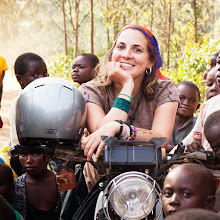
I have an idea. I go behind the barn and stand on the stone where I get phone service and send a message to Dusan. He recently got back from vacation and my idea won't work without him.
I want to teach anti-sex violence classes to soldiers. I need your connections and protection for that. Keep it in mind, let me know what you think. I send.
It doesn't take him long and he responds exactly how I expected, in that I didn't expect it.
Anti-sex? Or anti-violence? I'll contribute to the latter but not the first one!
Anti-sex VIOLENCE, I write back. I would never ask you to promote anti-sex.
I have to catch a plane in the next couple of days and I want to talk to him before I leave. He seems on-board but I want to pin it down. He tells me he'll be in Butembo the next morning, having drinks at the Hotel Butembo. I'm going back to the U.S. for a few weeks for several Congo and personal related things that require my presence; I need to leave my motorcycle with COPERMA, so I tell Dusan I'll drop in as soon as possible. COPERMA and I have planned to have a little dinner together--that I know I'll be paying for--to say bonne voyage. I'll be back in Congo in the beginning of November, but I'm not really sure they trust that.
In the morning I drive to Hotel Butembo first, so I don't have to hire moto-taxis the rest of the day. When I get to the Hotel I walk through the guarded gate into the compound, under the ivy arch and into a small field with plastic chairs and tables. I haven't been here in a while and the semi-western feel that used to comfort me makes me slightly annoyed now.
Dusan is sitting at one of the flimsy white tables with three other people, which I wasn't expecting. Faustin is here. Faustin is a handsome Congolese man who works for MONUC. About three months ago he told me that he is the ex-dictator Mobutu's nephew. Faustin explained he wanted to reclaim the family's power by running for the Presidency in 2011 and with me, an American, by his side he felt sure we could win. I told him I would think about it but then simply didn't go back to Lubero to see him. I didn't know how to tell him I didn't believe him, was slightly insulted he thought I'd marry for money and power, and was quite positive that even if it was true and I were a gold-digger, we'd both be killed within a month anyway. Now, sitting on the Hotel lawn it's definitely awkward and he's clearly mad at me.
He crosses his arms and glares at me when I sit in between Dusan and him.
-You fled Lubero, he says rigidly.
-I didn't flee, I just had a lot of work to do here in Butembo. You know how it is, you go where work takes you.
This doesn't placate him but thankfully Dusan interrupts.
-How are you? He exclaims.
He looks really refreshed. Every time he goes home for a few weeks he comes back looking around four years younger than before.
-I'm great! How was home?
-Wonderful, of course. I was just sending text message to you. I have idea.
He laughs before he can get it out, in a way that reminds me of a ten year old trying to say the word vagina. I can't help but laugh preemptively with him.
-What is it?
He's still laughing and can't seem to get the idea out.
-I think slogan for teaching soldiers should be Make War Not Love.
He slaps the table and practically falls off of his chair. I join his laughter.
-That's not a bad idea, I say. I mean, that's what we want them to do isn't it? Fight each other and leave the innocent people alone. Not a bad idea.
I can foresee a lot of disagreement with that title but it does make a surprising amount of sense.
-You can get t-shirts and everything, he says still laughing.
-Well, so what I'm thinking, I say, abruptly ending my laughter, is that all of this work with the survivors is so important, but it's not actually getting at the root of the problem. The soldiers, at least in this area, are the root of the problem.
I constantly have the image of chasing an unruly child through a house as he knocks over vases and destroys everything in his path. Everyone here is running around after the child picking up the broken pieces. I want to talk to the kid.
-I think this is great idea, he says.
He is serious again.
-Is great idea, and is possible idea.
-You think so? I need your connections to the Lieutenants, you would have to help me get to them and make their soldiers listen.
-Not any problem. This is easy part. Hard part is getting soldiers to remember morals.
-True. I'm thinking of going from a more self-centered perspective. If we show them educational videos on sexually transmitted diseases and HIV/AIDS, it won't be completely effective, but it could potentially make them at least hesitate before attacking women. I'm going to find the most graphic, painful looking images of inflamed penises.
-This is good idea. We will have to think more on this.
-Yes, I'm going to contact some people I know in Goma and Bukavu and see if they have any ideas. I think there may be one soldier education initiative around Goma, but I haven't heard much about it and there's obviously nothing up here in the bush.
-True. Well I am very interested, this is good idea. Oh, and I am Dusan, I am rude, yes?
-Um, yes. You are often a bit rude.
-This is my friend Rocky.
He points to a man in a MONUC camouflage uniform sitting next to him. I didn't even notice the man or our lack of social tact.
-Rocky is from Ecuador.
Rocky is a big man with sausage fingers. He smiles kindly at me and gets up a little to shake my hand.
-Hi Rocky, I say as my hand disappears into his.
I hold a sharp spike of my irritation out of my voice. I've heard the words Rocky, Ecuador and MONUC soldier in the same sentence before. This is the man who slept with Sonia, my prostitute friend in Beni. Rocky impregnated her and completely deserted her and his own son. Sonia's just happy to have a "muzungu" baby. The baby's lighter skin slides her social status upwards on the scale; although when I was trying to keep her from passing out on the floor of the dark club in Beni, she seemed to be flailing around at the bottom of the barrel.
Most men I know here are incredible people and I have to just let the other ones go. They're not worth my frustration, and it's not my place to be passing judgment. We all chat for a few minutes. Rocky doesn't speak great English and although I used to speak some Spanish I don't even try. All the French words in my head have stormed the castle and kicked the other residents out. Even my English is awkward. Dusan wants me to find a computer for him in the States, since electronics hardly exist here and in his home country they're extremely over-priced. Faustin is still giving me the silent treatment, and Rocky tries to follow the conversation but I can tell most of his laughter is of the I-don't-understand-but-you're-laughing-so-I-will-too kind.
-Well, I have to go, I say getting up from the table. I'll see you in a few weeks, stay safe everyone.
They all wave to me and smile, except for Faustin.
-Enjoy being home, says Dusan as I start walking away. And send message to your parents to warn that you are not pregnant, so when you get off plane they don't ask "who is the father?"
He crumbles into laughter again.
-Ha. Ha. I say not actually laughing.,
-I'm kidding, be safe.
Every Congolese person I know plus Dusan has effectively prepared me for coming back to the States with a few extra pounds on my person. I head back through the haze of dust to COPERMA. The crew is waiting for me and we all leave to go to a "night-club" down the road. A night-club in Butembo has to close at 6:30 p.m. and should really be called a late-afternoon-club, but I don't mention this to anyone. Inside of the dark club, the walls are covered in Christmas lights and there is even a stage for music. There are about eight of us and we order a round of drinks and two rounds of fried fish with frites. That's the only food available at the moment. I order a bottle of nine dollar champagne and when it comes to the table everyone claps. I'm the only one who knows how to open a champagne bottle and everyone laughs and claps again as the cork shoots out and I am covered by the excited bubbles that spill out.
-I've never had this before, Maman Marie exclaims. I am keeping the bottle forever.
She pours a small amount into each person's glass and we all cheers.
-I want someone to take a picture of what's in my stomach, Maman Marie says, happily pointing to her stomach.
I never knew cheap champagne could cause such a spark of happiness. It feels good to watch and feel responsible for. Everyone starts chatting back and forth. It's like a little family, and I'm a part of it. I don't understand them a lot of the time, they rarely get me, but we all care about each other. I look around at each person as they're laughing about the cultural differences that never get old. I love these people. Hangie pulls me out of my head and asks me what happens to women in the States when they get pregnant.
-The same thing as Congolese women, they're human too! Sickness in the morning, and they get kind of irritable at times. And they have really strong urges for specific foods.
This last one confuses him.
-Women here don't really get that. They do eat mud, though.
-Excuse me? Mud? Mud, as in dirt from the road?
-Yeah, he laughs at my surprise.
I don't believe him.
-Maman Marie, Hangie is telling me that women here eat mud when they're pregnant.
-Yes, she says immediately. I don't know if everyone does but most women do.
I make a note of this in my head. If I ever become pregnant, eat mud.
After several rounds of drinks, a lot of laughter and ten fried fish I pay the bill and we trickle out. I tap heads three times in the usual Congolese fashion with everyone except Maman Marie. She and I get in the rickety truck and Fisto, the driver starts towards the Crosier house in Musienene. I enjoy the familiar bouncing of the car and try not to worry about the rapidly diminishing light. Maman Marie and Fisto need to drive back to Butembo and I want the sun to wait for them; a brief pause in the sky, so these beacons of humanity can get safely home.
At the Crosier compound, Maman Marie gives me a hug and we tap heads three times. The hug feels great, because it's my culture not hers, and she knows that. As she drives away I realize I am ready to be back in the States for a brief minute. I miss the Congo and I haven't even left yet; but it will be nice to have a few changes, food being a big one. I like the Congolese food but with the amount of palm oil they eat with everything I can feel my chances of developing heart disease increasing with every meal. I can't wait to see some lettuce on a plate. Not to mention, it'll be pretty nice to not stick out like a sore, swollen, infected thumb for a few weeks.
Later, I recount the evening to a friend in the United States and she tells me that American women eat mud too.
Wednesday, October 6, 2010


Wednesday, September 29, 2010
Recent Post, Guest Blog
Please check out my most recent post, Notes from a Young American in Congo: Contraception, for Nicholas D. Kristof of the New York Times.
Saturday, September 25, 2010
Hangie on Children and the Church
Driving a motorcycle is like driving a car and riding a horse at the same time, temperament and personality included. After only four months, the chain on my motorcycle pops off while I'm driving it; I find myself walking the monstrous thing back to the Crosier house, in heavy boots and no socks. Four months is pretty good, considering it was made in China with less than quality parts, dissembled, sent to Congo and then put back together again. I have nothing against Chinese production, but people here often refuse to buy things with the MADE IN CHINA stamp, so the motorcycle break-down doesn't surprise me.
After making it back to the house I am able to get a moto-taxi. Maman Marie went to the Girl-Mother center in Magherya yesterday and we are supposed to head out to Isale today, in order to follow-up with the Rotational Credit. By the time I get to the office, I have open blisters on the backs of my heels. My socks disappear here faster than I can realize they existed in the first place. Hangie is sitting in the main room when I enter, and he laughs at me as I carefully pull off the heavy boots and start walking around barefoot.
-Where is la Maman? I ask. We're supposed to be going to Isale today.
-She's still in Magherya, they spent the night there.
He sounds a little worried and he's looking at his phone every three seconds.
-Have you not heard from her? Do you think she's okay?
-Yeah, I'm sure it's okay. She was supposed to come back last night though.
There is never service up in the mountains where the girl-mother center is located, so there's no way to check on her safety. She's been through a lot, though, she's one strong lady. We both dismiss the soldier-images in our minds and try to have faith in the world.
-Hangie, can I ask you a question?
-Yeah, of course, what is it?
He stutters a bit when he speaks, which used to confuse the French for me, but now I find it rather endearing.
-We've already talked about this a bit, but can you explain more why you want to have eight children? If you could sum it up in one or two sentences, what would you say?
Hangie has one child right now, a bouncing baby boy named Gabriel. Hangie considers himself relatively well off because he has a job and an education. We've discussed the idea of having a baseball team of children several times, but the massive families still frighten and frustrate me. I can't wrap my head around it.
Hangie looks at the floor and starts tapping his finger on his chin.
-There are so many reasons, it's hard to sum it up in one or two sentences.
-Just give me the first couple of reasons.
-Well, the first reason is, in the African culture, especially here in Congo. Socially, chez les Wanande, to have eight or more children is a richesse. Children in general are a richesse.
He always gives me this answer, but I see children as money munching monsters, especially when they exceed the level of two or three. Coming from a culture where having only a few children, depending on the size of your bank-account, is seen as responsible, I just can't understand the word richesse in connection to 10 mouths to feed and educate.
-The second thing follows the first, he continues. Many people love a lot of children because we love to see them around. We love children!
He looks up and smiles at me.
-Hangie, I love children too, but I'm not going to start birthing ten of them as soon as I get married. Okay, I've explained to you that I think it contributes to poverty, because the more children you have the more mouths to feed, the more school fees to pay. You never really give me a straight response to that. What do you think about it, honestly?
-It's true, first of all. We've already accepted that, but people aren't informed that having lots of children brings poverty.
-But you're informed and you still want eight children. I don't get it.
I'm kind of attacking him, but he's a pretty good friend at this point and we often have open discussions like this. I know he won't take it personally. He makes fun of my weird American ways and I sputter about not understanding the cultural subject of the day.
-You don't consider yourself poor right now, but if you have eight children you will be poor!
He laughs.
-Let me explain a little more. I want to have eight children, but right now, I know that I can't afford to have even one more. When we had Gabriel, my wife was in the hospital for two months and it cost 600 dollars.
-600 times eight is...
He rightfully ignores me.
-I want to have another child, but in my heart, I know I can't afford even that one hospital visit. I may not tell my wife this yet, but I don't have the means right now, so we won't have another child. Yet.
-Another thing I find conflicting, for me personally, is that the Church forbids the use of condoms and la pillule. I understand family planning can be plausible in some situations, but it doesn't seem that way to me, in this context. What do you think about that?
-About the Church?
-Yeah.
He pauses and taps his chin again. Baseme has entered at this point and is sitting on the couch behind Hangie, silently listening.
-The Church sees the sperm as already human. They do contribute to the poverty, because the Church does the opposite of sensibilisation. They don't teach about effective family planning. And family planning is so important. Family planning is smart.
He draws out the last word, and even says it in terribly pronounced English.
-Do you know what smart is? He asks.
-Yes, Hangie. I know what smart means. I speak English.
-No, SMART. S-M-A-R-T. Specifique, Mesirable, Acceptable, Realizable dans les Temps.
He stands up and writes it on the piece of paper in front of me.
-Ooh, I like that. I'm guessing you learned that in a formation session?
-Yeah, and the Church doesn't say it's smart. They say it's not smart. The Church says, when a man needs a woman, the woman should always come to him, with no discussion. And when the woman needs her husband the man does not have to come to her, he can refuse.
-What? That's ridiculous and extremely sexist.
I'm not sure where he's going with this.
-If I say, I need you physically, the Church says you can't say 'I'm not available,' you have to just say yes.
-Not possible. That's absurd!
I'm getting fired up. But I know Hangie doesn't actually believe that. I've met his wife, and eaten lunch at their home. He's kind and patient and doting.
-The Virgin Mary accepted to carry Jesus in her womb. When God asked her to carry his child, she accepted. She set the example and all women must follow her lead. That's what the Church teaches.
I'm almost positive the general Catholic Church does not say that, if they do I'm never looking at a Priest again. Despite knowing this, I take the bait like it's my last meal. Also, it's entirely possible that the Church Hangie attends in Butembo preaches this.
-I hate that Hangie! If what you're saying is true that is horrible. The Church is hurting the people! That's the opposite of holy, that's evil, pure evil!
-How so?
-What you're saying is rape. I don't care if it's a married couple or what. If a woman, or a man for that matter, doesn't want to have sex, it is entirely their right to choose and act on that choice. There's such a thing as marital rape. What you're saying puts men up here--I lift my left hand in the air--and women down here.
I throw my pen on the ground, grab my boot that's lying on the floor and start pounding the pen with it. Hangie and Baseme are both laughing.
-The woman has to obey her husband, he says when I sit back down on my chair. The Church says the woman must be ready at all times.
I have nothing left to say. I tell Hangie he's crazy and the Church is as crazy as him if what he's saying is correct; we all laugh about our opposing sides. It's like standing on two sides of a brick wall; I can hear him talking but can't visualize a damn thing he's saying.
I ask if he would mind buying me some jyoro-jyoros, sandals a bit like Crocks, but more attractive and a lot less expensive. Everyone in the rural areas wears them and when I wore mine in Goma I realized they are actually a symbol of being from the country and thus being poor. People in Goma thought my shoes were more funny than my skin. My blisters are too gaping to stick my feet back in the boots, that are now scattered across the floor. Hangie is more than happy to help and bounces out of the office.
Baseme is still in the room and hasn't said a word.
-Do you agree with what he was saying?
-No! Of course not.
-So you don't agree with what he says the Church says?
-No, I don't agree at all.
Baseme is a woman of few words. She's 25 years old and has a seven year old daughter named Eliza. Baseme was the first victim of rape I met when I moved here. She has been raped three times, all by civilians. starting when she was 16 years old. Any time I ask how she is doing, her response always redirects the conversation to the needs of Eliza. If Eliza is fed and in school, Baseme is happy. That's all there is to it, no matter the past. Her strength amazes me.
Hangie gets back with the jyoro-jyoros and I leave on a moto-taxi. Back at the Crosier house I ask the two brothers currently around what they think about Hangie's words. They say that none of that follows with Catholic ideals. The Crosier brothers tell me the Catholic Church teaches that in all situations it has to be a mutual, consensual act within a marriage. For both the man and the woman.
That puts me at ease again, I let the bait go and calm down. Yet, the frightening thing for me isn't just the Church ideals, but how people interpret them, priests and congregants alike, and how far backwards that can take us.
After making it back to the house I am able to get a moto-taxi. Maman Marie went to the Girl-Mother center in Magherya yesterday and we are supposed to head out to Isale today, in order to follow-up with the Rotational Credit. By the time I get to the office, I have open blisters on the backs of my heels. My socks disappear here faster than I can realize they existed in the first place. Hangie is sitting in the main room when I enter, and he laughs at me as I carefully pull off the heavy boots and start walking around barefoot.
-Where is la Maman? I ask. We're supposed to be going to Isale today.
-She's still in Magherya, they spent the night there.
He sounds a little worried and he's looking at his phone every three seconds.
-Have you not heard from her? Do you think she's okay?
-Yeah, I'm sure it's okay. She was supposed to come back last night though.
There is never service up in the mountains where the girl-mother center is located, so there's no way to check on her safety. She's been through a lot, though, she's one strong lady. We both dismiss the soldier-images in our minds and try to have faith in the world.
-Hangie, can I ask you a question?
-Yeah, of course, what is it?
He stutters a bit when he speaks, which used to confuse the French for me, but now I find it rather endearing.
-We've already talked about this a bit, but can you explain more why you want to have eight children? If you could sum it up in one or two sentences, what would you say?
Hangie has one child right now, a bouncing baby boy named Gabriel. Hangie considers himself relatively well off because he has a job and an education. We've discussed the idea of having a baseball team of children several times, but the massive families still frighten and frustrate me. I can't wrap my head around it.
Hangie looks at the floor and starts tapping his finger on his chin.
-There are so many reasons, it's hard to sum it up in one or two sentences.
-Just give me the first couple of reasons.
-Well, the first reason is, in the African culture, especially here in Congo. Socially, chez les Wanande, to have eight or more children is a richesse. Children in general are a richesse.
He always gives me this answer, but I see children as money munching monsters, especially when they exceed the level of two or three. Coming from a culture where having only a few children, depending on the size of your bank-account, is seen as responsible, I just can't understand the word richesse in connection to 10 mouths to feed and educate.
-The second thing follows the first, he continues. Many people love a lot of children because we love to see them around. We love children!
He looks up and smiles at me.
-Hangie, I love children too, but I'm not going to start birthing ten of them as soon as I get married. Okay, I've explained to you that I think it contributes to poverty, because the more children you have the more mouths to feed, the more school fees to pay. You never really give me a straight response to that. What do you think about it, honestly?
-It's true, first of all. We've already accepted that, but people aren't informed that having lots of children brings poverty.
-But you're informed and you still want eight children. I don't get it.
I'm kind of attacking him, but he's a pretty good friend at this point and we often have open discussions like this. I know he won't take it personally. He makes fun of my weird American ways and I sputter about not understanding the cultural subject of the day.
-You don't consider yourself poor right now, but if you have eight children you will be poor!
He laughs.
-Let me explain a little more. I want to have eight children, but right now, I know that I can't afford to have even one more. When we had Gabriel, my wife was in the hospital for two months and it cost 600 dollars.
-600 times eight is...
He rightfully ignores me.
-I want to have another child, but in my heart, I know I can't afford even that one hospital visit. I may not tell my wife this yet, but I don't have the means right now, so we won't have another child. Yet.
-Another thing I find conflicting, for me personally, is that the Church forbids the use of condoms and la pillule. I understand family planning can be plausible in some situations, but it doesn't seem that way to me, in this context. What do you think about that?
-About the Church?
-Yeah.
He pauses and taps his chin again. Baseme has entered at this point and is sitting on the couch behind Hangie, silently listening.
-The Church sees the sperm as already human. They do contribute to the poverty, because the Church does the opposite of sensibilisation. They don't teach about effective family planning. And family planning is so important. Family planning is smart.
He draws out the last word, and even says it in terribly pronounced English.
-Do you know what smart is? He asks.
-Yes, Hangie. I know what smart means. I speak English.
-No, SMART. S-M-A-R-T. Specifique, Mesirable, Acceptable, Realizable dans les Temps.
He stands up and writes it on the piece of paper in front of me.
-Ooh, I like that. I'm guessing you learned that in a formation session?
-Yeah, and the Church doesn't say it's smart. They say it's not smart. The Church says, when a man needs a woman, the woman should always come to him, with no discussion. And when the woman needs her husband the man does not have to come to her, he can refuse.
-What? That's ridiculous and extremely sexist.
I'm not sure where he's going with this.
-If I say, I need you physically, the Church says you can't say 'I'm not available,' you have to just say yes.
-Not possible. That's absurd!
I'm getting fired up. But I know Hangie doesn't actually believe that. I've met his wife, and eaten lunch at their home. He's kind and patient and doting.
-The Virgin Mary accepted to carry Jesus in her womb. When God asked her to carry his child, she accepted. She set the example and all women must follow her lead. That's what the Church teaches.
I'm almost positive the general Catholic Church does not say that, if they do I'm never looking at a Priest again. Despite knowing this, I take the bait like it's my last meal. Also, it's entirely possible that the Church Hangie attends in Butembo preaches this.
-I hate that Hangie! If what you're saying is true that is horrible. The Church is hurting the people! That's the opposite of holy, that's evil, pure evil!
-How so?
-What you're saying is rape. I don't care if it's a married couple or what. If a woman, or a man for that matter, doesn't want to have sex, it is entirely their right to choose and act on that choice. There's such a thing as marital rape. What you're saying puts men up here--I lift my left hand in the air--and women down here.
I throw my pen on the ground, grab my boot that's lying on the floor and start pounding the pen with it. Hangie and Baseme are both laughing.
-The woman has to obey her husband, he says when I sit back down on my chair. The Church says the woman must be ready at all times.
I have nothing left to say. I tell Hangie he's crazy and the Church is as crazy as him if what he's saying is correct; we all laugh about our opposing sides. It's like standing on two sides of a brick wall; I can hear him talking but can't visualize a damn thing he's saying.
I ask if he would mind buying me some jyoro-jyoros, sandals a bit like Crocks, but more attractive and a lot less expensive. Everyone in the rural areas wears them and when I wore mine in Goma I realized they are actually a symbol of being from the country and thus being poor. People in Goma thought my shoes were more funny than my skin. My blisters are too gaping to stick my feet back in the boots, that are now scattered across the floor. Hangie is more than happy to help and bounces out of the office.
Baseme is still in the room and hasn't said a word.
-Do you agree with what he was saying?
-No! Of course not.
-So you don't agree with what he says the Church says?
-No, I don't agree at all.
Baseme is a woman of few words. She's 25 years old and has a seven year old daughter named Eliza. Baseme was the first victim of rape I met when I moved here. She has been raped three times, all by civilians. starting when she was 16 years old. Any time I ask how she is doing, her response always redirects the conversation to the needs of Eliza. If Eliza is fed and in school, Baseme is happy. That's all there is to it, no matter the past. Her strength amazes me.
Hangie gets back with the jyoro-jyoros and I leave on a moto-taxi. Back at the Crosier house I ask the two brothers currently around what they think about Hangie's words. They say that none of that follows with Catholic ideals. The Crosier brothers tell me the Catholic Church teaches that in all situations it has to be a mutual, consensual act within a marriage. For both the man and the woman.
That puts me at ease again, I let the bait go and calm down. Yet, the frightening thing for me isn't just the Church ideals, but how people interpret them, priests and congregants alike, and how far backwards that can take us.
Friday, September 24, 2010
Recent Post, Guest Blog
Please check out my most recent post, A Soldiers Speaks (Sort of), for Nicholas D. Kristof of the New York Times.
Tuesday, September 21, 2010
Back to Kavingu
I haven't been to the Kavingu Girl-Mother center in a while, and I miss the girls. Things have been a bit hectic the past few days. I spent an entire day searching for cartons of notebooks for the kids. The school year has begun and the streets and villages are once again flooded with little nuggets in blue pants and white shirts.
Last week, at the end of the Crosier driveway, a young boy was riding a motorcycle too fast and without a helmet on, when he nicked the back of a large truck and disappeared. Brother Maurice told me in the morning.
-I didn't go close enough to see the body on the road, he said. I didn't want that image in front of my eyes.
When I left the house later that day, men from the village were covering the blood with shovels and sand. I stood there and imagined the boys youthful recklessness, ending in nothing. Motorcycles are the cheapest and most viable transportation here, but nobody wears helmets, everyone drives too fast and every ten feet is another blind turn. Younger boys typically drive the fastest, and often with three or four friends crammed onto the seat behind them. At least this boy was driving alone. As I leave the house for Butembo and drive past the spot where the boy disappeared, I realize how strange it is to start every day thinking about death.
At the COPERMA office, Urbain and an apprentice student named Pascal are inside reading through several documents. Pascal is very handsome and always extremely well dressed. He's currently reading about how to most effectively breed rabbits. The twelve that we bought for the people in Isale are all currently pregnant.
We all start chatting about nothing at all. Urbain starts in on me again about having babies. I've explained I'm not even close to ready for that, and am not sure if I want kids at all, unless they're adopted.
-You have to have kids! He says with his usual devilish smirk. For every four kids I have, you have to have one.
-What? Why?
-I don't know, just because.
-Okay, well you have two kids right now, so when you make it to four, you let me know and I"ll re-evaluate.
Pascal is laughing at us, still pretending to be reading about rabbits.
-Oh, Urbain, I met Hangie's family yesterday. We were talking about Gladys.
Gladys is Urbain's oldest daughter. She's a three-year-old firecracker. When Urbain and his wife invited me over for dinner, Gladys spent the entire two hours running in and out of the house, eagerly reporting on the bad deeds of all the children outside.
-Daddy, the kids are getting in the back of the car! But I can't kick them out because I'm not big enough. Why can't I be big like you right now? She yelled and stomped around the house, occasionally dropping to the floor in a mini-tantrum.
-She is a little character, I say to Urbain.
His face explodes into a smile.
-Yeah, she's a good one, he says, laughing.
I can't help smiling too; I love fatherly love. Especially here, where the evil in some men is beautifully balanced by the strength and love of the rest.
-I think I'm going to name my next daughter Gladay, he says.
-Gladay? Gladys and Gladay? Why do you want to name your kids practically the same thing?
-It's not the same. And I like the gluh, gluh, gluh sound. I don't know why.
We're all laughing now, even Urbain.
-You are ridiculous.
Suddenly, Hangie bursts in through the front door. He greets me quickly and sits down in a huff. All of us are looking at him.
-How would you describe the security here? If you needed to explain it, what would you say? He asks, looking at me.
-I would say, it's safe during the day but as soon as evening comes it flits out the window. Wooop! Like that. Soldiers turn into monsters and everything goes to hell.
They all laugh at my animations.
-Well said, says Urbain. Very direct.
-Although, I guess I would add, during the daytime it's only safe if you can avoid soldiers, there is no active confrontation, and nobody important was murdered the night before.
The group nods in more solemn agreement.
-Why do you ask?
-Someone from Germany was asking me about it and I couldn't figure out how to explain it.
The security here is like an adolescent going through an identity crisis. We're not laughing anymore. Maman Marie walks in right on cue. She hasn't been feeling well for a few days but has been driving out to Kavingu and Magherya with the potato root seeds that we bought. She even went to Magherya on a Sunday, which is unheard of in Catholic territory.
-We need to get going, I say. It's already 2 p.m. and we'll only have an hour in Kavingu if we don't leave right away.
Maman Marie agrees with me and we get into the truck with Urbain. Urbain often comes along to help Maman Marie, but also to translate the Kinande for me. As we're leaving the semi-smooth streets of Butembo, Maman Marie turns to me from the front seat.
-I have a good story to tell you! She's a bit ill, but looks as strong and eager as ever. When President Kabila was here last week, he drove down this road. He left Luotu at 6 p.m., so obviously the soldiers had already set up their barriers to steal from people. When he got to the first barrier, the soldiers threatened the car and tried to rob him!
-What? I say, laughing. FRDC soldiers tried to rob their own President? I love it.
-But he has a group of body guards, of course, so they chased the soldiers. There were three and they only caught one, but he's in prison now.
We're all laughing at the absurdity of it all.
-That is a great story. I love that. I'm sure he already knows, but now he can't deny how lawless his stupid soldiers are.
President Joseph Kabila Kabange came to Butembo last week to see the condition of the roads and supposedly lay the first stone of pavement. That wouldn't only help commerce and help ease the extreme poverty, but also make it more possible for people to get to the hospitals. I was pretty excited about it, until I heard that the road will stretch only 15 km, starting from the front door of his estate in Musienene and ending just inside the limits of Butembo; a Presidential drive-way.
When we get to Kavingu, the kids immediately swarm the car and fill the truck bed. I get out a little group of them follows me and stands in a circle of confusion, staring, from a distance, at my skin. I notice a little boy, maybe two years old standing off on his own crying. He's holding a wire attached to a toy car made out of dirty Styrofoam. The wheels don't exactly turn, but it follows him around nicely. He is crying pretty hard and I take a step towards the little nugget to pick him up. Immediately, his cries click up a few notches into terrified screams. I step back again, but the damage is already done. A monster in white is not easy for a two year old to understand. One of the other children walks over to him and with the touch of a single comforting hand the boy stops crying.
I turn back towards the small concrete buildings. One of the buildings is the classroom. It's made out of the usual horizontal carpet of sticks and mud, but there are already several holes in the walls. School has only been back in session a week, and the walls are already starting to crumble. I enter the concrete room where the girl-mothers are sewing. Inside the dark room there are about 6 black and silver sewing machines. There are two or three girls stationed at each sewing machine, working on various colors of cloth. The two formateurs are here as well, walking through, chatting with the girls and pointing out mistakes. The girls all look so happy.
We came out today mostly so that Maman Marie could show a video to the girls on the existence and effects of STDs/HIV. She immediately opens the little portable DVD player we just bought in Butembo and gets things going. The girls leave their sewing stations, chattering to each other and Maman Marie in Kinande. The door opens behind me and a flood of children sweeps into the room. In less than four seconds the number of people crowded around the tiny player has quadrupled. I'm not sure what language the DVD is in, everyone is chatting to loudly to hear it, but Maman Marie shouts memorized lines over the crowd as scenes flash through images and statistics of sexually transmitted diseases.
It doesn't seem the most effective way of doing this, but Maman Marie tells me that at the end of the film she asks the girls and boys if they will try to go to the hospital to get tested and treated; they always say yes. I go back outside and watch Urbain play around with the kids. He patiently lifts them into and out of the truck bed. I wish I could do that, it looks fun, but everyone would simply scatter and the fun would be over.
When Maman Marie has finished in the room with the girl-mothers, we all get immediately into the car. It's only four p.m but it takes an hour to get back to Butembo, and then 30 minutes for me to return to Musienene, which leaves a 30 minute cushion before the soldiers start really getting ready for the night. We get back to Butembo without any problems, the car doesn't even break down once, which is a treat. I immediately get on my motorcycle and chase the sun to the horizon.
When I pull up to the house, I approach the spot with fresh dirt, and remember the boy who's head was opened on the road. Occupying the same space where someone has lost their life is a strange thing.
At dinner, Brother Anselme says that an over-burdened truck tipped over just outside of Butembo, 10 people were killed. I'm getting used to this feeling of having death around all the time. It's like having another person sitting at the dinner table, by now.
Last week, at the end of the Crosier driveway, a young boy was riding a motorcycle too fast and without a helmet on, when he nicked the back of a large truck and disappeared. Brother Maurice told me in the morning.
-I didn't go close enough to see the body on the road, he said. I didn't want that image in front of my eyes.
When I left the house later that day, men from the village were covering the blood with shovels and sand. I stood there and imagined the boys youthful recklessness, ending in nothing. Motorcycles are the cheapest and most viable transportation here, but nobody wears helmets, everyone drives too fast and every ten feet is another blind turn. Younger boys typically drive the fastest, and often with three or four friends crammed onto the seat behind them. At least this boy was driving alone. As I leave the house for Butembo and drive past the spot where the boy disappeared, I realize how strange it is to start every day thinking about death.
At the COPERMA office, Urbain and an apprentice student named Pascal are inside reading through several documents. Pascal is very handsome and always extremely well dressed. He's currently reading about how to most effectively breed rabbits. The twelve that we bought for the people in Isale are all currently pregnant.
We all start chatting about nothing at all. Urbain starts in on me again about having babies. I've explained I'm not even close to ready for that, and am not sure if I want kids at all, unless they're adopted.
-You have to have kids! He says with his usual devilish smirk. For every four kids I have, you have to have one.
-What? Why?
-I don't know, just because.
-Okay, well you have two kids right now, so when you make it to four, you let me know and I"ll re-evaluate.
Pascal is laughing at us, still pretending to be reading about rabbits.
-Oh, Urbain, I met Hangie's family yesterday. We were talking about Gladys.
Gladys is Urbain's oldest daughter. She's a three-year-old firecracker. When Urbain and his wife invited me over for dinner, Gladys spent the entire two hours running in and out of the house, eagerly reporting on the bad deeds of all the children outside.
-Daddy, the kids are getting in the back of the car! But I can't kick them out because I'm not big enough. Why can't I be big like you right now? She yelled and stomped around the house, occasionally dropping to the floor in a mini-tantrum.
-She is a little character, I say to Urbain.
His face explodes into a smile.
-Yeah, she's a good one, he says, laughing.
I can't help smiling too; I love fatherly love. Especially here, where the evil in some men is beautifully balanced by the strength and love of the rest.
-I think I'm going to name my next daughter Gladay, he says.
-Gladay? Gladys and Gladay? Why do you want to name your kids practically the same thing?
-It's not the same. And I like the gluh, gluh, gluh sound. I don't know why.
We're all laughing now, even Urbain.
-You are ridiculous.
Suddenly, Hangie bursts in through the front door. He greets me quickly and sits down in a huff. All of us are looking at him.
-How would you describe the security here? If you needed to explain it, what would you say? He asks, looking at me.
-I would say, it's safe during the day but as soon as evening comes it flits out the window. Wooop! Like that. Soldiers turn into monsters and everything goes to hell.
They all laugh at my animations.
-Well said, says Urbain. Very direct.
-Although, I guess I would add, during the daytime it's only safe if you can avoid soldiers, there is no active confrontation, and nobody important was murdered the night before.
The group nods in more solemn agreement.
-Why do you ask?
-Someone from Germany was asking me about it and I couldn't figure out how to explain it.
The security here is like an adolescent going through an identity crisis. We're not laughing anymore. Maman Marie walks in right on cue. She hasn't been feeling well for a few days but has been driving out to Kavingu and Magherya with the potato root seeds that we bought. She even went to Magherya on a Sunday, which is unheard of in Catholic territory.
-We need to get going, I say. It's already 2 p.m. and we'll only have an hour in Kavingu if we don't leave right away.
Maman Marie agrees with me and we get into the truck with Urbain. Urbain often comes along to help Maman Marie, but also to translate the Kinande for me. As we're leaving the semi-smooth streets of Butembo, Maman Marie turns to me from the front seat.
-I have a good story to tell you! She's a bit ill, but looks as strong and eager as ever. When President Kabila was here last week, he drove down this road. He left Luotu at 6 p.m., so obviously the soldiers had already set up their barriers to steal from people. When he got to the first barrier, the soldiers threatened the car and tried to rob him!
-What? I say, laughing. FRDC soldiers tried to rob their own President? I love it.
-But he has a group of body guards, of course, so they chased the soldiers. There were three and they only caught one, but he's in prison now.
We're all laughing at the absurdity of it all.
-That is a great story. I love that. I'm sure he already knows, but now he can't deny how lawless his stupid soldiers are.
President Joseph Kabila Kabange came to Butembo last week to see the condition of the roads and supposedly lay the first stone of pavement. That wouldn't only help commerce and help ease the extreme poverty, but also make it more possible for people to get to the hospitals. I was pretty excited about it, until I heard that the road will stretch only 15 km, starting from the front door of his estate in Musienene and ending just inside the limits of Butembo; a Presidential drive-way.
When we get to Kavingu, the kids immediately swarm the car and fill the truck bed. I get out a little group of them follows me and stands in a circle of confusion, staring, from a distance, at my skin. I notice a little boy, maybe two years old standing off on his own crying. He's holding a wire attached to a toy car made out of dirty Styrofoam. The wheels don't exactly turn, but it follows him around nicely. He is crying pretty hard and I take a step towards the little nugget to pick him up. Immediately, his cries click up a few notches into terrified screams. I step back again, but the damage is already done. A monster in white is not easy for a two year old to understand. One of the other children walks over to him and with the touch of a single comforting hand the boy stops crying.
I turn back towards the small concrete buildings. One of the buildings is the classroom. It's made out of the usual horizontal carpet of sticks and mud, but there are already several holes in the walls. School has only been back in session a week, and the walls are already starting to crumble. I enter the concrete room where the girl-mothers are sewing. Inside the dark room there are about 6 black and silver sewing machines. There are two or three girls stationed at each sewing machine, working on various colors of cloth. The two formateurs are here as well, walking through, chatting with the girls and pointing out mistakes. The girls all look so happy.
We came out today mostly so that Maman Marie could show a video to the girls on the existence and effects of STDs/HIV. She immediately opens the little portable DVD player we just bought in Butembo and gets things going. The girls leave their sewing stations, chattering to each other and Maman Marie in Kinande. The door opens behind me and a flood of children sweeps into the room. In less than four seconds the number of people crowded around the tiny player has quadrupled. I'm not sure what language the DVD is in, everyone is chatting to loudly to hear it, but Maman Marie shouts memorized lines over the crowd as scenes flash through images and statistics of sexually transmitted diseases.
It doesn't seem the most effective way of doing this, but Maman Marie tells me that at the end of the film she asks the girls and boys if they will try to go to the hospital to get tested and treated; they always say yes. I go back outside and watch Urbain play around with the kids. He patiently lifts them into and out of the truck bed. I wish I could do that, it looks fun, but everyone would simply scatter and the fun would be over.
When Maman Marie has finished in the room with the girl-mothers, we all get immediately into the car. It's only four p.m but it takes an hour to get back to Butembo, and then 30 minutes for me to return to Musienene, which leaves a 30 minute cushion before the soldiers start really getting ready for the night. We get back to Butembo without any problems, the car doesn't even break down once, which is a treat. I immediately get on my motorcycle and chase the sun to the horizon.
When I pull up to the house, I approach the spot with fresh dirt, and remember the boy who's head was opened on the road. Occupying the same space where someone has lost their life is a strange thing.
At dinner, Brother Anselme says that an over-burdened truck tipped over just outside of Butembo, 10 people were killed. I'm getting used to this feeling of having death around all the time. It's like having another person sitting at the dinner table, by now.
Saturday, September 18, 2010
Recent Post, Guest Blog
Please check out my most recent post, Notes from a Young American in Congo: Caffeine! for Nicholas D. Kristof of the New York Times.
Thursday, September 16, 2010
Questions and Answers
I want, more than anything, for this problem to stop growing. Every time I think I understand the bigger picture, that I've reached the bottom of the stairs, the last step drops out from under me and everything just keeps falling. I help a few women who were raped, and I feel their hope and happiness flow through me; then on the way home I speak to someone like Kambale, who joined the army when he was ten years old, because CNDP soldiers started cutting off his arms.
He's young, he looks like he's still a teenager but he tells me he's twenty-one; he's been killing and pillaging for eleven years. He pulls up the sleeves of his army green uniform to show me the thick scars in the creases of each arm. I look at his face, as his Superior Officer, Muhindo, speaks to me. I don't listen to the lies he's telling me. He's speaking in a mixture of Swahili and Lingala, the language of the Western regions around the capital city of Kinshasa. Urbain is translating for me. The soldier speaks for several minutes at a time before letting Urbain convey the message to me.
So, I have plenty of time to look at Kambale. His eyelashes are thick and curl away beautifully from a set of very deep eyes. He's very pretty. He notices me looking at him and shifts his gaze around nervously. I make this soldier uncomfortable; this man with an AK-47 slung over his shoulder is nervous because I'm looking at him. I tune back in to what Muhindo and Urbain are saying. I just asked Muhindo what he is fighting for, since I don't see anything but greed and cruelty in this war; men using chaos as an excuse to let go of their humanity.
-The objective, says Urbain when Muhindo is finished, is so that Congo can be in peace.
-So, you're fighting to protect the Congolese people? I ask.
-Yes, to protect them from the insecurity in this area.
You are the insecurity.
The man has big teeth and bad skin. He's an officer so his army green has two flaps of navy blue on the shoulders. He smiles as he speaks and it's misleading.
-I've heard that a lot of the FRDC soldiers in this area are causing problems for the people, by stealing and raping.
Muhindo shifts his weight at the word viole, but maintains his composure well. His gun is pointing directly down at Urbain's foot.
-A lot of things go through my mind when I hear that, he says. It's not all soldiers who do those things. My unit doesn't do that, we're here to protect.
It's amazing how people can lie so easily. His unit is the 18th brigade and there's a woman dying in the hospital right now, because one of his men wanted to feel powerful for a few minutes. I want to slap him, but I just shake my head.
-What about rape? I talk to a lot of women who have been raped by FRDC soldiers. What do you think about that?
-When? Here?
-Yes, here. In the last few months.
-No, that's not possible. If a soldier rapes, he can be blindfolded and shot. Depending on the crime, he will at least be taken to prison.
-And what do you think? I ask, turning to Kambale.
He laughs nervously and looks to his Superior.
-A man who is guilty must be judged, he says.
He's still laughing. I wish I had talked to him alone. I feel like he wants to tell me things that are true, he doesn't want to be here wearing army green, not knowing where his family is. He told me when we first started speaking that he's tired, he's wanted to leave the army for a long time. Muhindo said that he can leave whenever he wants to, but Kambale silently shook his head.
-So, you're telling me that FRDC soldiers in this region don't rape women?
-I know one solder who raped a woman, Muhindo says. He's in jail now, for twenty-five years.
He says it like it's an example that will erase everything I've heard and seen. He knows that I know he's lying; it's just a game for him now.
-You can be honest with me, I mean, when there's an affrontement, things are really chaotic, and it's war after all. It would make sense if soldiers ended up raping a few women.
I hear the words flow smoothly and easily out of my mouth; I don't recognize myself. I'm a good liar too, it seems. Muhindo doesn't take the bait.
-No, we don't rape. We are allowed to take one woman, but no one outside of her. When we know what woman we want, we can get a letter from our Colonel and he will go with us to the home of her family. Then she becomes our wife. But we will be punished for sleeping with anyone else.
I've already been pushing things a little farther than I should. I don't explain to him that this is just extended rape. I'm laughing with him and acting like we're buddies. I need to do it, to try and get him to give me some more insight without him feeling threatened, but it's making me sick.
-Do you have a wife that you picked with the Colonel's help? I ask Kambale, still listening silently on my left.
-Yes, she's pregnant.
-Congratulations!
He smiles slightly and says thank you. He still won't look me in the eyes for more than a flicker of a second.
-I have three children says Muhindo, quickly, as if to show up his subordinate.
Urbain's phone starts ringing in his pocket. He pulls it out and I glare at him. Muhindo is watching him, clearly annoyed. Urbain puts the phone back in his pocket as the electronic rhythm comes to an end. Muhindo relaxes.
They're not giving us any actual information and it's getting close to dark. I thank Muhindo and Kambale enthusiastically and tell them I will bring several boxes of cigarettes tomorrow. Kambale's face lights up. I don't even know what to do with this man with the scars in his arms, who should still be a boy.
The truck is waiting a few meters down the road, with Maman Marie and the group of apprentice students standing in the back. In the car, I tell Maman Marie that the soldiers just lied through their teeth. Sylvain is also in the car and tells me it will be almost impossible to find a soldier who will tell the truth. After killing, torturing and raping, I guess lying wouldn't raise a moral red flag.
-I called Urbain because we need to leave now, Maman Marie says, as the driver starts up the car.
-What's wrong?
-You probably didn't see the man who walked by while you were talking. He is a soldier in this brigade but he is off duty so he wasn't wearing the uniform. He asked the driver if I was a woman who runs an aid organization in Beni. She has lied a couple of times to avoid giving the small amount of money to the soldiers at the road barriers, and they are looking for her to kill her.
-They thought it was you?
-Yes, but the driver told them no, it's not her. The soldier didn't seem to believe him, so we had to leave immediately.
-They want to kill her because she didn't give them the 20 cents at the road barrier?
-Yes! They are bandits.
-I'd better remember to bring those cigarettes, I mutter to myself. I'm exhausted and overwhelmed. I feel bad for the ten year old boy having his arms cut-off and being forced to give up his life. I hate him at the same time, because I know he's raped at least one woman, killed many and probably tortured in a similar way to what he experienced. I'm annoyed because they both acted like saviors. And I'm mad at myself for putting Maman Marie and all of the students in palpable danger, all because I wanted a few answers. Which, I didn't get anyway; just more questions.
He's young, he looks like he's still a teenager but he tells me he's twenty-one; he's been killing and pillaging for eleven years. He pulls up the sleeves of his army green uniform to show me the thick scars in the creases of each arm. I look at his face, as his Superior Officer, Muhindo, speaks to me. I don't listen to the lies he's telling me. He's speaking in a mixture of Swahili and Lingala, the language of the Western regions around the capital city of Kinshasa. Urbain is translating for me. The soldier speaks for several minutes at a time before letting Urbain convey the message to me.
So, I have plenty of time to look at Kambale. His eyelashes are thick and curl away beautifully from a set of very deep eyes. He's very pretty. He notices me looking at him and shifts his gaze around nervously. I make this soldier uncomfortable; this man with an AK-47 slung over his shoulder is nervous because I'm looking at him. I tune back in to what Muhindo and Urbain are saying. I just asked Muhindo what he is fighting for, since I don't see anything but greed and cruelty in this war; men using chaos as an excuse to let go of their humanity.
-The objective, says Urbain when Muhindo is finished, is so that Congo can be in peace.
-So, you're fighting to protect the Congolese people? I ask.
-Yes, to protect them from the insecurity in this area.
You are the insecurity.
The man has big teeth and bad skin. He's an officer so his army green has two flaps of navy blue on the shoulders. He smiles as he speaks and it's misleading.
-I've heard that a lot of the FRDC soldiers in this area are causing problems for the people, by stealing and raping.
Muhindo shifts his weight at the word viole, but maintains his composure well. His gun is pointing directly down at Urbain's foot.
-A lot of things go through my mind when I hear that, he says. It's not all soldiers who do those things. My unit doesn't do that, we're here to protect.
It's amazing how people can lie so easily. His unit is the 18th brigade and there's a woman dying in the hospital right now, because one of his men wanted to feel powerful for a few minutes. I want to slap him, but I just shake my head.
-What about rape? I talk to a lot of women who have been raped by FRDC soldiers. What do you think about that?
-When? Here?
-Yes, here. In the last few months.
-No, that's not possible. If a soldier rapes, he can be blindfolded and shot. Depending on the crime, he will at least be taken to prison.
-And what do you think? I ask, turning to Kambale.
He laughs nervously and looks to his Superior.
-A man who is guilty must be judged, he says.
He's still laughing. I wish I had talked to him alone. I feel like he wants to tell me things that are true, he doesn't want to be here wearing army green, not knowing where his family is. He told me when we first started speaking that he's tired, he's wanted to leave the army for a long time. Muhindo said that he can leave whenever he wants to, but Kambale silently shook his head.
-So, you're telling me that FRDC soldiers in this region don't rape women?
-I know one solder who raped a woman, Muhindo says. He's in jail now, for twenty-five years.
He says it like it's an example that will erase everything I've heard and seen. He knows that I know he's lying; it's just a game for him now.
-You can be honest with me, I mean, when there's an affrontement, things are really chaotic, and it's war after all. It would make sense if soldiers ended up raping a few women.
I hear the words flow smoothly and easily out of my mouth; I don't recognize myself. I'm a good liar too, it seems. Muhindo doesn't take the bait.
-No, we don't rape. We are allowed to take one woman, but no one outside of her. When we know what woman we want, we can get a letter from our Colonel and he will go with us to the home of her family. Then she becomes our wife. But we will be punished for sleeping with anyone else.
I've already been pushing things a little farther than I should. I don't explain to him that this is just extended rape. I'm laughing with him and acting like we're buddies. I need to do it, to try and get him to give me some more insight without him feeling threatened, but it's making me sick.
-Do you have a wife that you picked with the Colonel's help? I ask Kambale, still listening silently on my left.
-Yes, she's pregnant.
-Congratulations!
He smiles slightly and says thank you. He still won't look me in the eyes for more than a flicker of a second.
-I have three children says Muhindo, quickly, as if to show up his subordinate.
Urbain's phone starts ringing in his pocket. He pulls it out and I glare at him. Muhindo is watching him, clearly annoyed. Urbain puts the phone back in his pocket as the electronic rhythm comes to an end. Muhindo relaxes.
They're not giving us any actual information and it's getting close to dark. I thank Muhindo and Kambale enthusiastically and tell them I will bring several boxes of cigarettes tomorrow. Kambale's face lights up. I don't even know what to do with this man with the scars in his arms, who should still be a boy.
The truck is waiting a few meters down the road, with Maman Marie and the group of apprentice students standing in the back. In the car, I tell Maman Marie that the soldiers just lied through their teeth. Sylvain is also in the car and tells me it will be almost impossible to find a soldier who will tell the truth. After killing, torturing and raping, I guess lying wouldn't raise a moral red flag.
-I called Urbain because we need to leave now, Maman Marie says, as the driver starts up the car.
-What's wrong?
-You probably didn't see the man who walked by while you were talking. He is a soldier in this brigade but he is off duty so he wasn't wearing the uniform. He asked the driver if I was a woman who runs an aid organization in Beni. She has lied a couple of times to avoid giving the small amount of money to the soldiers at the road barriers, and they are looking for her to kill her.
-They thought it was you?
-Yes, but the driver told them no, it's not her. The soldier didn't seem to believe him, so we had to leave immediately.
-They want to kill her because she didn't give them the 20 cents at the road barrier?
-Yes! They are bandits.
-I'd better remember to bring those cigarettes, I mutter to myself. I'm exhausted and overwhelmed. I feel bad for the ten year old boy having his arms cut-off and being forced to give up his life. I hate him at the same time, because I know he's raped at least one woman, killed many and probably tortured in a similar way to what he experienced. I'm annoyed because they both acted like saviors. And I'm mad at myself for putting Maman Marie and all of the students in palpable danger, all because I wanted a few answers. Which, I didn't get anyway; just more questions.
Subscribe to:
Posts (Atom)


 Posts
Posts