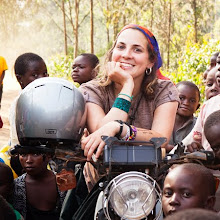
I wake up to rapping on my door and Dusan’s morning voice yelling “Baby! Is timing to working!” When I gather myself and step outside into the children’s courtyard, Dusan is already puffing on a menthol cigarette. The Muhanga compound is arranged like an F, with the main living quarters for Conchetta, Giovanni, and their V.I.P. guests located in the bottom and back part of the letter; the longest line. Between the bottom stick and the first horizontal, is a courtyard reserved for children. Even though Dusan’s knocking officially woke me up, every day in Muhanga begins with the six a.m. shrieks of happy children outside the window.
Maman Conchetta is a kind but feisty Italian woman who has lived alongside Father Giovanni for about 40 years. Father Giovanni is a Catholic priest, Conchetta is simply a woman who wanted a certain kind of life. She and Dusan have a never-ending battle of miscommunications. Dusan’s sometimes gruff demeanor and Conchetta’s solid refusal to take crap from anyone, make them constantly at odds.
-We must to take breakfast, if there is some food, with Colonel Safari and then to waiting the General, Dusan says when I emerge into the sunlight.
We walk across the children’s courtyard to a small brick building where NGO workers and the UN eat when they visit Muhanga. Inside there is espresso and a strange coos-coos concoction, supposedly left out from the night before. I greet Safari and pour espresso for each of us. Nobody touches the concoction.
-Bonjour Aime! Exclaims Safari.
I greet him and we tap foreheads three times in keeping with custom. Safari and I have met several times, the first being when he was in hiding near Goma. Safari had agreed demobilize through the United Nations, but for some political and military games, he ended up returning to the bush. Safari has a hard-head that looks like a bowling ball and dark eyes that are seated deep in his face. He’s appearance is frightening at first, but when he speaks he laughs every few words and I immediately enjoyed his company. I place the book I’m reading, Congo: Plunder and Resistance, on the table and sit next to Colonel Safari. Safari immediately picks up the book and begins scrutinizing it.
-I love reading, he says to me in French. Especially when it helps me learn English.
-That’s great. I love reading too. I think reading is very important.
He nods his head in agreement and continues silently flipping through the pages. Dusan lights another cigarette and pours another espresso.
-Coffee is not coffee without cigarette, he says and shrugs.
-Can I bring up the reason I’m here now? I ask in English.
I know Safari speaks some English but I don’t know how strong it is, and I’m sure if I speak quickly he won’t understand. The problem is, that Dusan doesn’t understand either.
-What? Americans speaking too fast.
I repeat the question more slowly, not really caring if Safari understands. He clearly does, as he lifts his head from the book and looks at me expectantly.
-Why not? Dusan asks, and then leans back to continue with his morning routine.
-Safari, I’m here because I was hoping to spend some more time with the Mai-Mai, so that I can understand better. I also want to hopefully help support your soldiers by giving them education they haven’t had access to and sensitization about sexual violence.
I continue explaining what I’m hoping, in the roundabout way I’ve learned from Dusan and nearly everyone he speaks with. When I finish, Safari responds immediately.
-It’s no problem, we’ll have to make sure with the General but I think it will be very good. You know, there was a Mai-Mai who raped a girl of 18 recently. And there were two civilians who raped women. They were all trapped and have already been transported to jail in Beni.
-Really?
I can’t hide how incredulous I am, not because of the rapes, but because Safari is telling me about them. Dusan prepared me for the fact that the Mai-Mai, as with any group, will be putting their best foot forward if I’m allowed to stay. Then again, the fact that the Mai-Mai was arrested and is in jail is another version of a best foot.
-Yes, he continues. I think the problem is ignorance. Most of the men don’t have the information or the knowledge to know that it’s not okay.
-I agree, I think education is very important. It’s not as simple as that, of course, which I know you know. And in order to figure out how I can help, in whatever small ways, I need to get a full image of your lives, your ideology, your everyday.
-Yes, he says nodding enthusiastically. It’s good to get a full picture. What we are doing is revolutionary, and people say we are such bad people. Maybe you can understand more and know that it is not so. And then you can tell other people this.
I agree emphatically to everything he says as I finish my espresso. Even though I poured Safari some coffee, he doesn’t drink caffeine so he sips on a glass of water. When Safari and I have finished our discussion, Dusan launches into a history of Italian politics, always connecting things to the situations in the ever changing Croatia. He stands up for about twenty minutes pointing to different spots on a map pasted on the wall that still references the Russian Federation as the U.S.S.R. Right when he’s really getting into it Father Giovanni walks in.
Giovanni is a kind man with a perfectly crinkled face. He’s lived most of his life in North Kivu. He’s soft-spoken but direct, and lets Conchetta handle everything involving the house. Giovanni, however, handles security.
-You are meeting with the General today? He asks after we finish greeting each other.
Giovanni doesn’t speak English, so I act as translator.
-Yes, says Dusan. You know, they have to making very good and intelligent decisions now. With pre-elections processes it’s very important that they are not playing the games they are normally playing and they are very careful and intelligent.
Giovanni nods at the beat-around-the-bush words. Giovanni brings up some names of various Officers in different groups who have been around, and rumors he has heard. Dusan is interested in everything but can confirm nothing. I feel like a child listening to adults, but am even more uncomfortable since they’re relying on me to communicate with each other; I can’t just listen passively and pretend not to.
When breakfast finishes, we all disburse. I go back to my room to read, Dusan disappears with a cigarette clinging frantically to his lips, and Giovanni disappears into the house to entertain four Italian guests. After a few hours, Dusan raps on the door again.
-Okay, let us go, he says with no further explanation.
I understand Dusan-speak better than anyone in Congo, and I realize immediately that the General has arrived. I follow Dusan around the house to the other side of the F where there is a long porch looking out on banana trees and hanging laundry, both waving nonchalantly in the wind. Father Giovanni is already sitting in a wooden chair, Colonel Safari is standing next to him, and a man who’s short and wide is standing against the railing. I walk straight up to the man against the railing.
-General LaFontaine, he whispers leaning his head towards me. His hand is pudgy and warm.
-It’s an honor to meet you, I whisper back not knowing why we’re whispering but feeling the importance of the meeting. I’m Amy.
LaFontaine leans back, still holding my hand, and emits a roar of laughter. The crackling coals of his whisper evaporate immediately as if they never existed. I laugh as well, though I also don’t really know why we’re laughing. I’ve heard stories about LaFontaine’s decisive violence. Whether or not it has been the “valid” violence of war, or cruelty I don’t know. But it’s well-known that he’s capable of it. I take a seat next to Giovanni, Dusan sits on my other side. The Mai-Mai sit across from us in a row. Two other men who are clearly Mai-Mai, join their row.
One of the new men is Colonel Vincent. Vincent and I met briefly the last time I was in Muhanga. He looks strikingly similar to comedian Dave Chappele and is quite handsome. The whites of his eyes don’t have the same stained tint as Colonel Safari’s do. The fourth man in the row is another Colonel I’ve never met and nothing in his features or demeanor stand out. He’s a phantom taking up space on the bench. I’m expecting Dusan to talk about UN business and Congo politics, but he begins immediately with me.
-I think it is very good for you to meeting Amy, she is doing very good work here in Congo. Very serious girl from United States, she will explain.
I’m speechless for a moment, shocked by the brevity of our introduction.
-Well, I’m here in Congo working with sexual violence, but I’m not here in Muhanga to accuse anyone. I’m trying to understand other perspectives and hopefully I can find a way that I can also help the Mai-Mai. I’d like to understand how the Mai-Mai live and what they think about, really everything. And then I’d like to show them some information and some films that can help with basic education and sensitization.
-So, General Lafontaine responds laughing inexplicably again. Will they get a diplomat of some sort if they speak to you? After they see your films and read your material will they graduate and have a certificate?
I’m thrown off by the question but quickly try to recover.
-Well, no. I don’t work for the government, or anything like that, so I can’t give Congolese certificates or diplomas.
-Who do you work for? LaFontaine asks. He’s not laughing anymore.
-I’m kind of an independent here, working with sexual violence.
Dusan understand the basic French in the sentenceand shoots me a look.
-I’m also attached to DDR/RR and the UN, I add quickly.
-You are from the United States, LaFontaine says putting his elbows on his knees and staring directly at me. You know, when we are raped in Congo it is the U.S. that is raping us. It is the U.S. and Rwanda who are raping the Congo. So maybe you should start with your own country.
Again, I’m thrown off balance. He makes a good point.
-Yes, I agree, I respond. I understand the U.S. is heavily involved and Rwanda as well. But my work is more on an individual basis and in areas that have less access to information and support.
Thankfully, Dusan cuts in. He seems to have understood the dialogue is moving towards discussion or argument. He starts explaining the “situation,” still equivocating and not actually asserting or denying anything. The elections are coming and things will be bad, everyone must to be careful, etc. He actually says, “I can’t confirming or denying anything,” several times. Maybe there is some esoteric meaning in the words, though I doubt it. Again, I am a child, nervous about participating but employed to transfer the meanings of their words. I translate.
Giovanni sits quietly next to me. He insists on being present when meetings are held in his parish, but he just listens. Giovanni is perpetually caught in the middle of a real life game of tug-of-war. He has to play the game, or at least monitor, otherwise he’ll be trampled after ever game.
Soon after Dusan begins talking business, his team members, Jay and Kensey, arrive. They pick up the job of translating. I’ve heard most of the information before so I mostly tune out the conversation and study the General. Despite his power and status as a rebel, the General makes me think of Santa Clause. He has a round belly and face with soft eyes and a smile like a fireplace in winter. As I watch him, the General stares directly at me and speaks in Swahili.
-Yes, I respond in Kinande as a sort of joking way of indicating I don’t understand.
-Did you understand, asks Jay.
-No, I say laughing.
-He says he is fine with what Dusan is saying but you, Jay raises a finger and points it at me. He says you could infiltrate them from here because probably you are FBI.
I laugh but the General clearly isn’t joking.
-Okay, with this maybe you should leave, says Dusan.
-I’m not FBI, I say in French, but I will leave.
I stand up and bow slightly to the General and the other Mai-Mai, then walk off the porch cussing to myself. On the other side of the F, in the children’s compound I pull out a cigarette I’ve been avoiding. Kensey quickly joins me.
-He thinks I’m FBI, now they’ll never let me stay, I say.
-It is because you are saying you are Independent, he responds laughing. There were people here a while ago saying Independent and they were investigators from America. Did you tell him you’re American?
-Dusan did, I say after thinking for a moment.
He throws his hands in the air and laughs.
-Now you’re FBI!
-No! That’s not good. I’m not FBI!
Kensey keeps laughing and I can’t help but join him. I like to think I’m relatively hardened and capable, but apparently even if someone tries to steal my phone and I skin my knee I’m going to cry about it. If the FBI were in Muhanga they’d be laughing with us. Kensey goes back around to join the conversation, but I’ve been condemned as a spy so I sit in a wicker chair and watch the kids. A little girl comes up to me and places herself on my lap.
One great thing about Muhanga is that the children are all accustomed to muzungus, though not just any muzungus. The internationals who thread through Muhanga stay for a month and go home. They don’t drive around in locked Land Rovers and aren’t fatigued by the constant presence of children, they relish it. Whether or not Big Brother in Congo is watching, the children always are; typically between eight and 40 of them. After a month the many eyes staring at you become heavy and exhausting. Mostly, the kids just watch and often cry if a muzungu gets too close; but in Muhanga they’re not afraid and it’s nice to be able to interact with them rather than simply exist as a perpetually entertaining alien.
-Are you okay?
I look up and see Colonel Safari standing next to me.
-Yes, I’m fine, thank you, I say once again confused.
-I hope you’re not uncomfortable, he continues. The General can’t trust anyone, you must understand that. He doesn’t mean to offend you. It’s like me when I first met you. Trust is always a process, but he’ll get to know you.
-No, I’m not offended at all, I say. I completely understand.
The fact that Safari is worried that I’m hurt by my excommunication from the group clearly signifies that he, at least, doesn’t think I’m a spy.
-Don’t worry, I’ll speak to him and explain more, he says.
He pats the little girl sitting with me on the head and then walks off with a wink.
Tuesday, August 23, 2011


Monday, August 8, 2011
Back to the Bush
We spend a few more days romping around Goma. My knee and finger don’t bend for a few days but gradually everything starts to heal. Then back through Virunga Park and into the mountains to Butembo. I only have time to drop off some donated funds for COPERMA before Dusan tells me we are going back to the bush, today. I’ve been pressing him more about the rebel project; traveling around with him is fascinating and always presents something new, but I want to start understanding the rebels so I can figure this conflict out a little better. To truly help, you have to understand as much as possible and understanding in Congo is quite elusive. Finally, a chance presents itself.
Over the potholes and through the trees to the Bush Bed & Breakfast we go. Jay and Kensey, Dusan's team members, both join us. Dusan’s job is becoming increasingly more convoluted and demanding as the elections approach. It hasn’t yet become clear which rebels are working with whom, and apparently nobody trusts anyone anymore. We leave late in the day and neither Jay nor Kensey are happy with the decision. As we go further into the bush the road gets worse and daylight quickly dims into night. The four wheel drive on the Land Rover can manage most mud but the car hydroplanes left and right, often barely missing ditches and wayward branches.
-No, baby, don’t do this to me, Dusan says out of nowhere.
As we approach a large truck completely stuck in the middle of the road he starts cussing in Croatian. There’s just enough room on the left side of the truck for the Land Rover to pass but the road is a swamp of mud, and where our driver’s side tire would pass, there is a deep ditch. It’s pitch black out and the truck seems diserted. Dusan stops before the tiny space next to the truck and keeps muttering cusswords. Jay and Kensey both get out of the car and disappear on the other side of the immobile truck. When they come back they are accompanied by about six men of all ages. The men are covered in dried mud.
-Stay in the car, says Dusan as he climbs out.
They start taking rough measurements of the space available and the width of the Land Rover. It looks like we can fit but the car will be scratched by branches on the left and the metal of the truck on the right. This is not safe territory to remain in and we can’t turn back at this hour so I’m sure we’re at least going to try. The men pull out shovels and start shoveling away the replenishing mud in the road. Some chop at the mud wall on the Land Rover’s left trying to make more space to pass.
-This is not good, says Dusan getting back into the driver’s seat. Hold on extremely tight.
He revs the engine, switches on the four wheel drive and we slide forward towards the tiny space. Just as we pass next to the front bender of the truck the left side of the Land Rover falls into the ditch and I’m lofted into the air. Dusan accelerates but the tires only scream at him. The car is irrevocably stuck and is slanted at a 50 degree angle. I have to hold onto the door handle to avoid tumbling onto Dusan. Dusan’s door is pinned against the mud wall so I have to climb out of the car in order to let him out on my side. My feet are sucked into the mud and I almost fall several times in the slippery darkness.
Dusan goes to talk to the mud covered men and the shoveling continues. I notice a light behind the truck and head towards it. The men have started a large campfire in the middle of the road.
-They’ve been stuck here for three days, exclaims Kensey when I sit down on a log in front of the crackling fire.
-Three days? Did they bring food to eat?
-I don’t know, he says. They must have brought something.
Within only a few minutes all of the mud covered men return to the camp fire and I hear more words of fire explode from Dusan’s mouth. I walk back to the car.
-They’re too lazy to helping us, he yells.
-They’ve been digging their truck all day, retorts Jay. They are not lazy they are tired.
I agree with Jay.
-This is not good. I have never stucking overnight. Ever.
Dusan walks off to speak to Kensey by the fire.
-We’re going to sleep here, says Jay. I always say we need to leave early. And I am always right and Dusan never listens to me. I’m always right and nobody every notices!
-You were right Jay, I say and pat him on the back. I noticed.
He walks over to Dusan and Kensey still sulking. They chat for a few minutes and I stand in a puddle of mud surrounded by a cloak of blackness. The cloud cover is too think to see the stars and the only senses I have are the coolness of the night air and the insect sounds filling the blackness all around me.
-We need to call Father Giovanni, Dusan says, returning to the car. We have to use the satellite phone. Do you have his number?
Both Jay and Kensey shake their heads. Dusan pulls out the SAT phone anyway, hoping to call someone who can give us the number. Father Giovanni is the head priest in the community where we are going. I've named it The Bush Bed and Breakfast, since it's in the middle of what's referred to as "the bush," yet has internet, 24 hour electricity, a washing machine, and the best Italian cuisine south of Sudan. When Dusan pulls out the SAT phone he cusses some more, this time in English and Croatian.
-Kurats Usladuledu, f#$*ing phone. Battery is dead.
Jay and Kensey both laugh.
-Let’s charge it, says Kensey.
When he finds the charger, they have to tape it to the phone to get it to work. Now to get service. With the cloud cover the service is almost non-existent. Seeing as Dusan has been reduced to pure profanity, I walk back over to the fire and Jay follows me. When I get there they are roasting something on a stick. It looks like a hand puppet. When I take a closer look, I see what looks like the charred remains of an extremely large rat; it’s mouth is open in a scream and it’s arms stick out straight with no paws on the end. It looks like a smaller version of the swamp rat that attacks Wesley in The Princess Bride. The animal has been cut in half and there is light red blood filling the inside.
-What is that? I ask.
-It’s like a porcupine, says Jay.
-Did it have spikes when they caught it?
It looks nothing like a porcupine.
-No, it’s not a porcupine actually. It’s a forest rat.
I lean in to take a closer look as the guys all laugh at my astonishment. I work hard to keep disgust off my face.
-They said they got lucky today, Jay translates for an older man in the group. They haven’t eaten almost anything in days, but today one of them caught this rat.
Jay points to one of the younger guys. The guy takes out a machete, places the bottom half of the rat on the log he’s sitting on and begins hacking it into small pieces.
-It’s good meat, says Jay.
All I see is black flesh and shiny red blood; no meat. The older man who just spoke points to me, points to the rat and then makes the motion of eating.
-Thank you, that’s very kind but I don’t want to take any of your small meal.
Jay translates and the men all see the nervousness written on my face and laugh.
-That could make me sick, right? I ask Jay.
-Yes, it’s better not to eat it.
-Bonne appetite! I say.
Jay and I walk back to the car, sharing the one flashlight we have. Kensey is perched on the window sill of the passenger’s side door holding the SAT phone up to the sky for service. After several attempts and a few broken conversations, Kensey is able to contact Father Giovanni. Giovanni doesn’t know if he can help, but he’ll see if there are men willing to come at this hour with a car. They’ll need a Mai Mai escort since this is Mai Mai and FDLR territory.
-Well, why don’t we to eat something? Dusan says when everything is tentatively arranged.
Everyone gets back in the car. Due to the slant I have to put my feet on the side of Dusan’s seat and hold onto the door handle. It’s like sitting on top of a steep roof with only one side of the roof to work with. We pull out the salami, bread, and cheese that we brought and Jay and Kensey bring out cans of sardines.
-It’s a picnic! Yells Jay, laughing.
Kensey pulls out a bottle of Hunter’s Choice Whiskey.
-The best picnic ever!
He fills the top of the bottle with whiskey and hands it to me.
-Your glass, Madame.
-Thank you.
We eat quickly and with a small measure of whiskey in each of us we settle in for the night, uncertain whether or not people will come to help. Dusan is comfortably pressed against his door, cozily weighted down with the pull of gravity. I, on the other hand, have a bit more trouble. I consider opening my door and hanging out but with the other men nearby Dusan won’t allow it. I curl into a fetal position but have to cling to the door handle and wrap my arm over the side of my seat to stay aloft. Finally, after a few hours of cramping and clinging, I’m able to hook my body in just such a way as to not have to actively hold on and still stay in one place. I begin to drift off.
-They’re coming? I hear Dusan mumble in his sleep.
-Yeah, maybe they’ll come, I mumble back.
Kensey is stretched out on the back seat snoring loudly; Jay is curled up in the trunk.
-No, they’re coming! Dusan yells.
I sit up quickly, forgetting to grab the door handle and almost tumble onto Dusan. I grab it just in time and see headlights moving towards us through the darkness. The mud covered men are sleeping under a large tarp in the middle of the road and at first I’m afraid the car will drive over them, but the car stops and the men stumble out from under the tarp. Within seconds there are men by my window.
-Bonsoir! Each of them says smiling at me.
At first I think they’re the guys who tried to help us earlier and I’m amazed at how quickly they jumped from sleeping to digging. I soon realize these are the men Giovanni sent; the other guys are stationed around the coals of their fireplace once again. The new men work quickly, digging mud from around the tires and attaching a long yellow cord to their car and ours. I stumble around groggily, trying to comprehend their energy and not lose a shoe in the mud. After about 30 minutes they’ve towed the car free of the ditch, the mud, and the truck. Jay, Kensey, and I hoot in celebration and Dusan gives me a high five. It’s almost 3 a.m. We make it to Father Giovanni’s around 4 in the morning and every single one of us immediately collapses into a horizontal bed.
Tomorrow we are to meet with the General of the Mai Mai group. General Kakule Sikuli Vasaka LaFontaine, leader of the largest and most influential Mai Mai group currently in Congo, has walked several days through the bush to meet with Dusan. I'm going to throw in my two cents and see where it lands; the goal is to stay for a while.
Saturday, August 6, 2011
Recent Post, Guest Blog
Please check out my most recent post, Notes from a Young American in Congo: Mental Health, for Nicholas D. Kristof of The New York Times.
Friday, July 29, 2011
The Candy Shop
Ah, Goma. The city of wazungu, whiskey, and prostitution. After dropping off the bullet man, Dusan and I snake our way through the grey city to the House of the Former Yugoslavia. Understandably, individuals working for the United Nations tend to clump in houses based on nationality and language. In our large green house over-looking Lake Kivu there are two Serbians, one Croatian, Russians and Ukranians in and out, and then randomly two gentlemen from East Timoor. When we arrive Dusan immediately pours us each a small glass of Johnnie Walker Red Label Whiskey. Even if there is work to be done, Goma is always a slight vacation for both of us; friends, fancy restaurants, and flirtations abound.
One of the Serbian men in the house is Zander; a hopeless romantic though married man with children. His story is nothing new. Most of the International men in the mission, once away from their wives and children, relive their glory days or create ones if they never had them. After briefly catching up and settling in, Dusan, Zander and I go out for a quick dinner (lasagna and escalope cordon bleu—with whiskey on the side) then out to the clubs. Most clubs are “off limits” for United Nations workers due to the plethora of sex workers and the inability of the men to resist. Goma is truly a candy shop filled with little boys, each running around gaily picking candies off the shelf. Try one put it back, move on to the next brightly colored sparkling sweet thing.
It’s not like in Butembo; even though the Association of Women Living Alone consists of 6,000 women who are all potential sex workers. In Butembo you can spend hours in a local nightclub and never know that every woman inside is looking for a fare. In Goma you can’t walk through the door without having beautiful smiles and over-enthusiastic laughter clinging to you like smoke. At B-Club we meet up with our friend from a previous trip, Charlie. Charlie is an international who has been living in Congo for several years. The club is full, the dance floor is throbbing and neon lights make everyone glow different colors. Dusan immediately gets to work. He flits through the crowd greeting women he knows; a hug here, a peck there.
-You know, I don’t get it, says Charlie, bringing me a beer. I’ve fallen off the wagon a few times when really drunk and taken home a woman, but I always hate it and it’s never fulfilling. Even if the woman speaks a little bit of English there’s never any semblance of a connection. It’s mostly just depressing.
We both sit on the back of an outdoor couch and watch the gyrating crowd, sparkling under a disco ball.
-Yeah, that’s how it seems like it would be to me. But then again, I don’t know anything anymore. I used to be kind of uncomfortable with all of this but now it’s just like, who cares?
-I can’t judge them. The women. They need to make a living and this is the best way to do it. I just don’t like to be the one helping them make a living.
-Yeah definitely. And I guess for the men, as long as they aren’t abusive or disrespectful, it’s their business. But, I mean, like Zander, for example.
I point into the crowd where Zander is actually speaking to a woman he knows from Croatia.
-I’ve spoken to him a bunch about this. He truly believes that women he takes home are genuinely interested in him, rather than simply looking for money. But the woman he’s seeing right now has a Congolese boyfriend. It’s well known. And she often asks him for exorbitant amounts of money.
Charlie laughs.
-I don’t get it either. Here, let me get you another beer.
He gets up and walks back into the fray. I sidle over to a standing table where Dusan has joined Zander and the Croatian woman. Dusan introduces me as his bodyguard and personal secretary before they switch back into Serbo-Croatian chatter. Every now and then Dusan jumps away from the table to say hi to a newcomer.
-Nice enough legs, normal size, good ass, yeah? He says returning to the table, as we both watch the woman walk into the crowd.
After every woman he inspects her body and asks me what I think. I’ve never checked out so many women in my life. It’s strange, and I feel like I too am treating the women like different shaped pieces of candy.
-I just got offered two free blow-jobs, says Charlie returning and handing me a beer.
Dusan breaks into laughter.
-Both said it would be the best in my entire life, continues Charlie laughing too.
-Yes, always it will be the best, says Dusan.
Dusan is pulled back into the Yugoslav conversation by Zander.
-I told them it would cost them thirty dollars, Charlie says and we both laugh.
-That’s a perfect answer. I bet they were pretty confused.
-Yeah, they thought I meant I would pay them, but I said no, you’ll have to pay me. They declined.
I laugh for a moment and then we both fall silent. I’m tired of talking about sex workers; whether sizing up their beauty or discussing the ethical complexities, it makes up 80 percent of the conversation in Goma.
-So, Charlie, I say. You’ve been in the mission awhile right?
-Yes ma’am. A few years.
He takes a cigarette out of his pocket and lights it; another characteristic of United Nations living. He hands the pack to me and I slide out a bad decision and light it.
-Well, I continue. So many people in the U.N. talk about what they don’t like about working in a mission or how hard it is. And I know it’s not easy, it’s a very solitary life and your job is everything. But then people also stay in for so long. And I’ve heard you say that you missed out on things in your country, for example. I guess what I’m getting at is, do you regret it? Or, if you had the chance would you do it differently?
Charlie takes a drag from his cigarette and thinks for a moment.
-I don’t think even if I wanted to do it differently that I could.
-What do you mean?
-I think to live this kind of life you have to have something a little off. Emotionally, chemically, I don’t know. But people who live this kind of life and do this work are people who maybe seek out being alone or solitary. They’re able to handle loneliness but maybe they also seek it out.
-Do you feel like an outsider even when you go home?
-Of course, he laughs. This is a parallel universe. How am I going to have small talk at home about talking to murderers and rapists?
-Yeah, I know what you mean.
-It’s hard for people to understand because… this is Congo. We live here. And it’s not sensational and it’s not thrilling and it’s hard. It’s living and it’s up and down but within a parallel universe. I mean, I’ll spend the day with rebels who are murderers and then go kill people in a game on my Xbox.
He laughs.
-It’s fucking weird, man. But to be honest, I don’t feel anything anymore; unless I decide to.
He looks at the ground and then gives me a c’est ca look.
-I think I’m starting to understand that, I say.
-Oh well, that’s life my friend. But I need a break.
-Baby! Dusan says, prancing over to us.
He leans over and gives me a kiss on the forehead. He always gets a little fatherly-affectionate when he’s drinking.
-I think we must to go to another club. The titty situation here is not so good.
He and Charlie laugh.
-Were you doing titty reconnaissance? I ask.
-Yes! Exactly! Titty reconnaissance, I’m liking this. But let us go yes? It is good idea?
-Sure, I say. The titty’s all look the same to me anyway.
We walk to a nearby club with an outdoor bar under a gazebo. Again, Dusan greets various women, but there’s a problem. Zander’s current love interest is present and she’s ignoring him. He sits at a table and starts glaring at her.
-Uh oh, this is not good, says Dusan making his way back to me. We must to watch him all night. I am not understanding this, it is not good. You know, I am telling him he should just have fun talking to these women and such but not bring them home. You know, I am not bringing them home. I am dancing and enjoying but then I am giving them money for taxi and saying, go.
He makes a shooing motion with his hand.
-I will give them some money to helping them but I don’t want to take them home with me. But Zander, no. He must not only sleep with them but get emotionally involved. This is terrible business, I am telling you.
-He looks pretty angry.
Dusan walks over to the plastic table where Zander is sitting and glowering at a woman. Zander’s face is dark; he looks exactly like a little boy who’s lollypop was stolen. The woman is a girl, she’s only 20 according to Zander. But she’s tall, slender, has an eyebrow piercing and holds herself as if the entire scene will disappear on her say so. She’s beautiful but I can see that she’s calculating her movements and directing them at Zander.
-He needs to stay away from that, says Charlie offering me another beer.
-Yeah. He’s kinda like a child even though he’s almost 40. Most of the men are in Goma.
Suddenly, I’m enveloped by dark wavy hair, the thick smell of perfume, and arms around my waist. I lean back and see a woman who’s famous as a sex worker in Goma. While the 20 year old Zander is staring at thinks she is controlling the room, this woman is always in control.
-Hey baby! Glad to see you, she yells.
She starts to sway her hips and dance around. I join her for a few half-hearted minutes before telling her my legs are tired. She practically sashays off to someone else she knows. She knows everyone.
-She’s impressive, says Charlie leaning against a wooden pole of the straw roofed gazebo.
-You mean attractive?
-No. Well, she’s okay. But she is the Queen Bee, the Mother Hen and she has been for years. It’s amazing these women stay alive at all; it’s a dog eat dog business.
It’s true. Even though there are no pimps in Goma, it’s not an easy business and there’s a strictly regulated hierarchy.
-Yeah, I respond. I spoke to a beautiful young girl from Burundi last time I was in Goma. She said she started selling sex to send her younger siblings to school. Both of her parents were killed in Burundi so she and her siblings moved to Goma. When she first started coming out to the clubs she was beaten up several times by the more established sex workers.
-They have to maintain their structures, he says.
I nod my head and watch a rather large man with white hair, clearly over sixty, grind on the dance floor with a gorgeous woman who can’t be more than twenty.
-I’m going to go ask Dusan something, I sigh and walk off.
I’m ready to go home.
-Don’t worry about it, I say patting Zander’s back when I get to his table.
Dusan seems to take my presence as his ticket to freedom and he bounces off towards a young woman who’s dancing very seductively. Zander doesn’t want to talk so I sit with him and watch the young girl pull his puppet strings. Finally, after a few more songs and Charlie’s departure, we’re able to tear Zander away from slender girl with the ‘tude. We walk back up the street to the first club where the car is parked but when we get there the gate is closed. Dusan pounds on the metal and Zander shakes his head, clearly still thinking about the girl.
It happens so fast I don’t even hear myself scream. Within a second someone’s arms grab me and throw me onto the ground. The phone on a cord around my neck was the target but the cord doesn’t break. Within an instant Zander is next to me helping me up.
-Amy! Are you okay? He yells.
Before I can respond he yells, “your phone!” and runs off after the young man and his friends. Zander catches them at the end of the road where there is an intersection. I stumble forward holding my phone in front of me.
-He didn’t get it! I try to yell but it comes out more as a squeak.
Under the dim orange light of a street lamp I can see Zander’s fist rise into the air and then drop towards the man on the ground. The man’s friends are doing nothing, just watching in a stunned circle. Zander is a huge man and his anger has been simmering without climax all night.
He’s going to kill him, is all I can think.
The light from the street lamp perfectly surrounds them like a spotlight; it makes them look like they are glittering.
-He didn’t get it! I try again, but the sound that comes out is still pathetic.
I’m moving too slowly, but Dusan appears from behind me. He moves in front of me and runs to where Zander is still on top of the man. I don’t know if Dusan pulls him off or simply yells at him. Once I see Dusan moving to control Zander I look away from them and start to take inventory. My knee is bleeding and swollen and my left pinky finger is definitely jammed. Both of my hands are bleeding and the left part of my chest is already throbbing.
-Are you okay? Zander asks again when he gets back with Dusan.
He’s breathing heavily.
-Yes, I’m fine. Thank you for helping me. They didn’t get my phone.
I give him a hug as someone finally opens the gate. As we walk to the car Dusan and Zander speak rapidly in Croatian cusswords I understand. Yebenti Matera! Kurats!
-You know, there was a police officer there with a gun, says Zander switching to English. For a second I almost took the gun and killed him. I was afraid I would kill him.
-So was I, I say softly.
Zander gives me another protective hug before we climb into the car and the adrenaline that flooded my system starts to dissipate. I know I’m okay but my body is trembling and I try to conceal it when I start crying. It’s embarrassing in front of these two military officers but with the declining adrenaline it’s completely out of my control.
-Fucking Goma, says Dusan. That police was helping them to attack you. You saw he was right there when they grabbed you and he did nothing. Why were you behind us? You should have been in front of us. This should never to happen. Did you speak to those guys? Didn’t you see them?
-I was only a step or two behind you, I say defensively. And no, I barely saw them. He grabbed me from behind.
I can tell he’s just angry that I was hurt but I’m not so excited about the insinuation that it was my fault a guy tried to rob me. Back at the house Zander uses vodka to clean my hands and knee and then seems to realize he has iodine and uses that. They discuss the situation some more, venting their anger. I finally succeed in calming the trembling in my body.
-Well, I’m okay, you’re okay and you’re okay, I say after a few moments, with a steady voice. And they didn’t even get my phone! So, life is good, yeah?
-Yes, says Dusan. This is good way of thinking.
-Well, thank you for your help gentleman. I think that was enough excitement for me for one evening. Goodnight.
I leave them sitting on the porch, where Zander stays for another few hours hoping the young sex worker will stop by as promised. She doesn’t and the candy shop closes for the night.
Monday, July 18, 2011
This is Africa, Baby
The “Congolese” FDLR rebel who was recently shot, has admitted that he is Rwandese. With this new information the United Nations mandate covers him and he can be helped. Dusan and I are to pick him up from the hospital in Kaina and continue the 4 hour drive across the bumpy roads to Goma.
-That trip is not going to be comfortable, I say to Dusan before we leave Lubero.
The morning of our departure I drove the motorcycle from Butembo to Lubero, and am now waiting for Dusan to “wake-up.” Even if he wakes up at 9 a.m. he often needs to sit on a couch in his pajamas sipping coffee, Coca, and cigarettes until well after-noon. He told me to be in Lubero no later than ten, but it’s already noon and he’s lighting another cigarette.
-I don’t care for his comfortability, says Dusan putting the cigarette to his mouth.
-Well, I’m just saying with six recent bullet holes, riding in the back of a landrover is going to suck.
-I don’t to care, he says more forcefully. This guy is piece of shit. Absolute piece of shit. You know why he was shotted? He went to kill a motortaxi driver and the passenger to steal the moto. The passenger was an officer in the FaRDC and shot back. So, because of this, I don’t care of his comfortability. Piece of shit.
I nod my head in contemplation and relative agreement. I’ve mostly stopped trying to decide what I think about things or how they make me feel. It’s all too confusing and layered at this point to make any headway. After another two hours, Dusan finally calls Jay to come pick us up and we head south to Kaina together. Jay is not happy about the time of departure and he huffs into the back seat before settling in with his arms across his chest, muttering about driving at night. Dusan is relatively quiet, something which only happens when he’s completely exhausted or in serious contemplation. I’m somewhat grateful for the reprieve.
We arrive in Kaina just after evening falls and we go straight to the hospital. The man has been transferred to a more private room. He’s lying stretched across two beds, this time with his bandages showing. He has been shot four times in the chest and twice in the leg. We’re taking him to Goma to have his leg amputated at a better hospital. Something in his face looks somewhat smug this time, and the intensity of his gaze on me makes me reflexively zip up my jacket. I shudder, and leave the room.
Tilapia fish, rice, cabbage, Coca, and cigarettes, in a nearby restaurant before the three of us glide through the silent darkness of the village to a local parish with decent lodging. Watch a movie, go to bed. In the morning Jay and Dusan ask a few local guys to help them fix something on one of the tires. The back of the Land Rover is open and there are several mattresses and a blanket rolled up inside.
-I’m assuming those are for the man to lie on? I ask Jay when he walks up to me.
-Yes, he will sleep on it. And there’s one other guy from Kaina who will be back there.
I stop speaking and imagine the semi-smug guy from yesterday. It slips out of my mouth before I finish formulating the thought.
-That’s going to smell terrible, I say and cringe immediately.
Jay gives me a look. Not exactly the most compassionate reaction.
-Don’t worry we’ll open the windows, he says.
-Yeah, I’m sure it’ll be fine I say, trying to sound like less of a jerk.
It wasn’t the most compassionate response, no, but the smell of healing and dying flesh mixed with the metallic odor of blood and antiseptic is one of the most horrible recipes I’ve encountered. I remember it well from my years as a volunteer Emergency Medical Technician Co-Pilot.
Before we can remove the man from the hospital, we need permission from the FaRDC commander. The FDLR soldier is technically under arrest for being a rebel, and for attacking an FaRDC officer. The governmental military camp is only a few minutes away from the hospital. It’s not what I’m expecting. Most FaRDC camps are huts made with sticks and draped with tarps and cloth; they’re old-fashioned tents that can be easily destroyed and moved. This camp is a large, Belgian era building and when we drive in there are several uniformed soldiers playing volleyball in the yard. They smile and give us a thumbs-up as we drive by. We’re taken to a large stick gazebo to escape the full force sun and speak with the Commander.
After a few minutes a squat man with a wrestler’s body and an intelligent face walks in. He’s wearing civilian clothes and shakes all of our hands without smiling. Officers never smile.
-So, we are here to speak with you because under the United Nations mandate, we can to remove the man who was shotted and take him to have better care. I need to let you know we are not taking him to release or give special treatment. We are not here to letting terrorists free. When we are to transfer him, we will to inform the FaRDC battalion in Goma and they will to take over his arrest. He can to be repatriated in Rwanda, if FaRDC says this is okay, or he can to be tried and judged in Congo. We are simply to get him to better hospital care.
Jay translates and the Commander nods his head knowingly. When Jay finishes the man leans forward in his chair.
-For your mission, this is not problem for me, he says. I know very well about DIH –Droits International Humanitaire—(International Human Rights) in fact I am the one who said he needed to be taken to the hospital. He needs to get the best treatment possible so that he can get better and live, and then he will be judged in accordance with either Rwandese or Congolese law. For me, what you are doing is not a problem.
Interesting, an FaRDC officer who seems to be genuinely concerned with the law. It probably would have been easier to kill the FDLR rebel, and more often than not, that’s what happens. This Commander is a positive anomaly.
-Great, says Dusan after Jay translates. And I want to say thank you for all of the work you are doing and thank you for the operations you performed recently. We were able to extracting many from the bush so thank you.
The Commander smiles slightly and nods his head some more.
-We must to continue this work we are doing, Dusan continues. And the most important thing is peace. This is most important thing. We are to finishing what we started.
We all stand up and shake hands. Into the sun, back in the car, return to the hospital. I follow Dusan into the room where the man is still being held and treated. When I walk in his bandages are bloody and the smell engulfs me like an invisible wall of smoke. There is a sickening addition to the smell; something is not healing properly. I resist the urge to put my hand over my nose and mouth but turn and walk back into the warm, fresh air.
-Don’t worry, says Jay walking up beside me. They will clean the wounds.
-Yeah, it’s okay. I’m not worried about it.
Dusan joins us and we start unrolling the mattresses and cleaning the dust from the back of the car. The space is only large enough for one man, sitting up. Dusan drives the car over to the door leading to where the man is staying and props the back doors open. Jay and I stand a few feet away and stare at the car. Through a back window I can see Jay’s red backpack poking up next to a roll of toilet paper. It looks like we’re going on a camping trip.
-The space is not big enough, says Jay. This man will suffer greatly.
-Why didn’t we get an ambulance? I ask.
An ambulance is just a Land Rover with no backseats, but at least the man would be able to lie down.
-I don’t know. Ask Dusan.
He says it as if either he simply doesn’t want to have to deal with the task, or he thinks Dusan did it so that the man would suffer.
-This man will die, he says.
-Today?
-No, but soon. He is shot all across the chest.
He points to four spots, more or less covering his lungs.
-It’s amazing he’s alive at all, I say. Especially in Congo.
-Yes. You see.
Jay walks off to inspect the back of the car and Dusan walks over to me and lights a cigarette.
-Dusan, why didn’t you get an ambulance?
He looks down at me as if I just asked what country we’re in.
-Because, he pauses. If I am asking for ambulance this will take several months to arrange and they will not to go until security escort is come. Man will die and then they will say, okay we are ready. Come on, Amy.
He pauses and then pats me on the back.
-This is Africa, baby.
-Dusan, says Jay walking back to us. I think we can lower the back seat and make enough room for the man to lie down.
-You think so?
Dusan tosses his cigarette onto the ground and the two of them walk back to the car. Within a few minutes they have pushed the back seat up and the mattresses fit easily.
-You and me will both sit up front with Dusan, says Jay.
-Ҫa va.
When they’ve finished cleaning the man’s wounds and given him a shot of pain medication, six nurses carry him out on one of the mattresses. He looks like a skeleton. His normally high cheekbones are like wooden slates propping up the skin on his face and his body seems to sink into nothing once his ribs end. I smile at him but he looks through me. Someone places the blanket across his body and sets a plastic bag next to his head.
-Okay, we are to go, says Dusan. We must to pick the other guy.
I climb into the front seat next to Dusan and Jay climbs in on my right.
-I think we will to reach Kivanga in a few hours and we will stop to take some omelete.
-With the guy? I ask pointing behind me.
-No, of course he won’t eat he’ll stay in the car.
If I had a man riddled with bullet holes and a leg to be amputated in my car, I definitely would not stop for omelets. But Dusan always knows best so I keep my mouth shut. A few minutes down the road into Kanyabayonga village we pull over to pick up someone who will watch over the bullet man. A young man climbs into the car carrying a bag that’s long and clinks. He sits down awkwardly next to the bullet man’s head and tries to find a place for his feet. There is almost no space. The door opens again and another man climbs in.
-You’re both coming? I ask surprised.
-Yes, one responds.
The door opens again and a third man climbs in.
-Jeez, I mumble and shake my head.
One man drapes his legs across the bullet man who is staring at them with wide eyes. The third guy squats next to the bullet man’s chest. If the car swerves he will definitely land on the man’s chest wounds.
-Okay, let’s go.
-Three people? I ask Dusan.
-Yes, why not? It is fine. Don’t worry. Hakuna Matatiso- No problems.
Our first flat tire occurs on the mountain descent leading to Virunga National Park. One of the guys in the back, who calls himself Charlie Hotel, starts changing the tire. Dusan walks up to me and takes my arm. He has a small stick in his hand and he pretends to poke me in the arm with it as if it’s a syringe.
-Sorry, I have small veins. They always have trouble sticking me, I say.
-No, this is what they are telling you. But really they are having trouble because you have too much grass.
Grass is Dusan’s word for fat. He starts chuckling to himself. I kick a stone at him.
-No, I know this is small veins issue, I’m only kidding, he says.
I reach out and point to his veins which are large and clear under his skin.
-Well, you’re old, I say.
-Oooooh! He howls. Now it is one to one yes? This is good!
He raises his hand and gives me a high five and then walks off still laughing.
Charlie Hotel only takes a few minutes to change the tire. You can’t drive in Congo without a spare so we have to make it to the Indian battalion in the Park. It’s about an hour drive to the Indian battalion, if we get a flat we’ll be stranded with a dying man in the car. Dusan drives less carefully than Jay and I are comfortable with. Both of us wince and make exclamations each time a tire hits a sharp hole.
-Hakuna problemas! Says Dusan. Don’t worry so much.
We make it to the Indian battalion and they are able to switch the tube in the flat tire. It takes about an hour and I stay in the sweltering car, glancing back at the bullet man from time to time. I watch him slowly untie the knots in the plastic bag by his head to reveal a piece of stale bread. His hands tremble as he slowly rips off pieces and brings them to his mouth. I consider trying to help him but can’t figure out anything to do.
-You know what is funny, Dusan says returning to the car. We have three weapons in the car and they are pretending to watching security. It is funny, you know. And one of these guys with us is an ex-combatant. He’s being extracted too. They can to be attacked even from inside.
I remember the clinking plastic bag one of the guys brought in. Two FDLR ex-combatants and three AK-47s in the car, but the bullet man couldn’t use a gun if he wanted to, and the other ex-combatant seems pretty mild. They finish repairing the tire but the outside casing of the tire has also split, and before we drive off again, Dusan points out the wire they used to stich the split together. There’s no way it will hold.
We leave the Indian battalion and drive for about an hour before Jay rolls down his window and I notice the loud fssssssssssssssssss coming from the front tire.
-Stop! He exclaims.
We climb out once again and Charlie Hotel gets to work. I notice that the third man in our car is wearing a t-shirt that says, CAUTION: Alcohol Testing- Risk of projectile vomiting, verbal diarrhea, gaseous emissions, uncoordinated movements.
The area of the park we are in is one of the least secure pieces of passable road in North Kivu. A German NGO worker was shot in this stretch a few months ago and people are often attacked and looted. Jay seems to notice this at the same time.
-This is great. If we are to be attacked, this is the place, I’m telling you. This is where they are.
He nods his head in the direction of the FDLR ex-combatant.
-Yeah, but we’re with their friends so maybe they won’t attack us, I say.
-Are you kidding? He says and laughs. This gives them more reason to beat us because we are extracting their people.
It’s an interesting balance. On the one hand we’re trying to save the life of one of their soldiers, and on the other we’re decreasing the number of their forces.
-Okay, finish! Says Charlie Hotel standing up. But this is not strong tire so you should drive carefully.
Back in the car. Jay climbs in next to me and explodes in laughter. We’re all a bit giddy at this point.
-The minibus behind us stopped! He says still laughing. They thought we were being looted and they were getting ready to run.
Dusan takes off, and caution is not a word that could be used to describe his driving. Jay winces for the tire, I wince for the bullet man.
-Should we to let the minibus pass? Dusan asks, accelerating as the minibus climbs up on our left side.
Dusan has a thing about other vehicles not passing him, even though when others don’t let him pass he always yells that they are just trying “to showing the dick size.” Jay and I respond at the same time.
-We have a sick man, I blurt out.
-The tire! Yells Jay.
Dusan hunches his shoulders and stops accelerating.
-A minibus to passing us, he mutters.
Suddenly Jay lets out a shriek next to me.
-EEeeeeeeeeeeeeeeee!!!! An Elephant!! Dusan, Dusan!
Dusan slams to a halt in front of a massive elephant standing next to the road. Jay and Dusan both climb out of the car and take turns taking pictures standing next to the elephant. When Jay gets back in he’s ecstatic and makes me look at the photo of him next to the elephant at least three times. He’s Congolese and his excitement confuses me.
In Kivanga, we stop for omelettes, fries, and fried chicken. We need to fix the spare tire again, so we have an excuse to order more than just omelets. The sun is setting and shortly after leaving Kivanga the tire pops a third time. Charlie Hotel sighs and cusses a few times but takes a cigarette from Dusan and changes the tire again quickly. Jay mumbles some more about why it’s important to leave in the morning and not lounge around smoking cigarettes. I glance constantly at the bullet man and the three other men continuously tell me everything’s okay.
After about six hours we make it to Goma and drop the bullet man off in the DDR/RR repatriation camp. He made it through alive and only verbally acknowledged his pain towards the end. Just outside of Goma, I see a half-broken bicycle with three boys clinging to it as it rockets down the road. The boy in front is wearing a white shirt that’s miraculously clean in an atmosphere heavy with grey dust. On the front of the shirt in large block letters it reads: I HEART PARIS HILTON.
This is Africa, baby. Whatever that means.
Saturday, July 9, 2011
Genocide
Mangurajipa is inaccessible by road. While preparing to leave, Jay, Dusan’s translator, speaks with several truck drivers who attempted the road and had to turn back. I’m disappointed that we can’t go to the village I’ve been curious about since speaking with a gold salesman, but also glad we didn’t start the trip and have to spend hours digging the car out of the mud in an area where safety is never a certainty.
The next day Dusan calls me.
-We will go to Kaina, he says. To Arrange The Things.
I wonder to myself if I’ll ever be able to have a professional meeting without referencing The Things. Kaina is south of Lubero, so I head out on my motorcycle to meet Dusan and his team in Lubero. There is nothing like driving across the rocky, potholed, muddy roads of Congo on my motorcycle with music playing under my helmet. The country is beautiful no matter where you go, no matter how bad the roads are. Women carrying bundles of sticks and babies line the roads, next to men pushing goods on toothpick bicycles. Even when the rains threaten, there is something comforting about Congo. The country is a well-intentioned but cruel lover, and no matter how it hurts you or those around you, you can never stop loving it.
In Lubero, after Dusan smokes a few cigarettes and all phones are charged, Jay, Dusan, another team member named Kensy, and myself pile into the UN car. Kaina is only three hours away, a short distance in comparison to most DDR/RR trips. We hurtle through the countryside as Dusan gives history lessons and discusses The Things with Kensy and Jay. When we arrive in Kaina the sun is just beginning to set. I don’t know what Things we are arranging but we pull into the dirt courtyard of a small hospital.
-I think we should speak first with the Commander of FaRDC, says Jay.
My heart pops into my throat and I have to work hard to suppress it. With all of the rebel forces in Congo, the governmental forces frighten me the most. They have the “law” behind them, no matter how corrupt or non-existent that law is and thus they have more power than simply the power of a gun. They cause more chaos in this country than any rebel, but much less than any politician.
-We have to check The Things first, says Dusan.
All of us file out of the car.
-What are we doing here? I ask Dusan.
He’s wearing his black sunglasses to shield the sharp rays of the setting sun.
-We must to see a man who was shot.
-Is he FaRDC?
-No, he’s FDLR. He was shot in some ambush.
A man wearing a Doctor’s white coat comes out of one of the small concrete buildings to speak with Jay and Kensy. When they finish Kensy turns to us and translates.
-The man is having his wounds dressed, we must wait about thirty minutes.
-Okay, says Dusan puckering his lips. Let us go to take something to eat.
Back in the white vehicle, ten minutes up the road to a small concrete building where we stop often to take tilapia fish and Coca-Cola. Dusan immediately starts with a history lesson. His favorite topics are World War I, World War II, and of course, the wars for Independence of the former Yugoslavia.
-You know in World War II 80,000 victims were German. And about 30,000 were Russian, he says across a large wooden table as we wait for our food.
-I heard, even though it’s not normally a good thing to mention, that there have been more people killed in Congo than in World War II.
He pauses.
-I will not say like this. But yes, it can be true. You have over six million victims in Congo but it is over the course of more than ten years. In World War II it was over a few years, and then in Rwanda it was 800,000 victims but in the time of a month or so.
-Why is it so hard for people to admit that? The comparison of victims.
-You know, United Nations reports pushing governments to admit this is genocide, but Rwanda is furious because they must to have claims to that word.
-Well, I thought that genocide was ethnically based. And from as far as I can see, even though there are ethnical reasons and aspects to the conflicts here, mostly it comes down to money, minerals and power.
-What is genocide? He asks and leans forward knowingly. What?
I hesitate, as whenever he looks at me knowingly it typically means I will eventually be wrong no matter my response.
-Genocide is the attempted extermination of a group of people based on ethnic lines?
-Okay. What about religion?
-Um…. I think it means trying to exterminate an entire group of people. I'm not sure how they draw the lines that make people different.
-What about if it is ridding people in order to profit from what they have? Is profit enough to make differences?
-Uh… I’m not sure. I can look it up though.
I pull out my kindle, one of my most precious traveling companions, and open the The New Oxford’s English Dictionary.
Genocide- n. the deliberate killing of a large group of people, esp. those of a particular ethnic group or nation.
-So, says Dusan when I finish. You are telling me this isn’t genocide? Deliberate killing of a large group of people? Baby. This is genocide.
-Yeah. That’s true.
-And baby, it will only get worse. Nobody can see this as genocide because it has happened over many years. But over six million victims, all deliberately killed. This is only genocide. Minerals or not minerals, this is genocide Chief.
I nod in agreement.
-Okay, I think we will to go, he says suddenly.
Back at the hospital we walk into a common room with beds and patients. Most are women, many are elderly. Only the young man wrapped in the blanket stands out. Dusan mentioned he is a war criminal, meaning he either partook in the Rwandan genocide or has committed atrocities in Congo. The guy looks vulnerable and nervous as the four of us surround his bed. The only part of him that pokes out of a brown patterned blanket is his face. He’s young but looks relatively healthy.
-Let us go to wait outside, Dusan says to me.
Jay and Kensy stay, as they speak his language. The point of the meeting is to find out if the UN can help him. If he’ll admit he’s Rwandan, he can be considered someone to repatriate and the UN can help him get back to Rwanda.
-He is saying he is Congolese, says Jay emerging from the room after only a few minutes.
-Does he know we can’t to help him if he does not tell the truth? Asks Dusan.
-Yes, we explained. But he is saying he is Congolese. He was shot many times, at least three, possibly up to eight. They are to amputate his leg.
I listen as he speaks and think of the absurdity of all of it. He can only be helped if he admits he’s Rwandese, even if he is in fact Congolese. And no matter his war crimes, repatriating him is better than having him in Congo to wreak havoc. His wife is still in the bush, supposedly, and nobody knows if he has children. He ambushed the FaRDC, allegedly, but wasn’t looting. He’s a member of FDLR but isn’t Rwandese. If he is Rwandese he’s helped by UN but potentially ostracized by his country of origin. I hate this conflict, I hate the complexities; I hate the never ending aspect of not being able to actually help or make progress. There are too many hands in the cookie jar.
As the sun gets lower and lower it permeates even the shade. I watch a little girl of about two years old imitate her mother. She looks like a sixty year old woman, in a dirty green frilled dress, with her squat little body and knowing face. She takes sticks and pebbles and dumps them into a little hole in the ground before pounding a rock into the hole and stirring with another stick. She’s making stew. I wish I could simply watch her forever and revel only in the perfection of her imagination.
Saturday, July 2, 2011
Voyagers
Two days and twenty hours of driving later, Dusan and I arrive in Lubero. It is the rainy season; at night there is no light but the lightning. I always seem to sleep best in Lubero. The darkness and the silence of the village envelope my mind and calm the many thoughts and frustrations of the day. The next day, after another two hours of driving, Dusan drops me at home in Butembo.
I have some Things To Arrange in Butembo for a few days. When I’m done, I’m eager to get to COPERMA and happy to see my colleagues diligently working in the main room when I arrive. All of them greet me with enthusiastic hellos and complaints about how long I was gone.
-You have become une voyagere! Exclaims Maman Marie with a tinge of disappointment.
-Yes, I’m sorry, but I’m still a part of COPERMA.
-Amy, says Hangie walking in from one of the smaller offices. There are the three survivors of rape here.
He points to the wall behind me, and I turn around and see three familiar faces I completely missed on the way in. All of them smile at me and greet me in Kinande, knowing now that I can respond. I greet them back, shake hands with each woman on the thin wooden bench and bow my head slightly before following Hangie into the small office he came from.
Even though I’ve been working wiith COPERMA for over a year now, there are still cultural divides in communication, especially in terms of money. Several months ago I had to arrange to have only Hangie speak to me about money; it was too overwhelming receiving requests and needs from everyone on the team.
-That’s great the women came for their follow-up, I say once we’re alone inside the tiny concrete room.
-Yes, they came on motorbike, but Amy we don’t have the money to pay for them to go home. They will walk for several days. And they need to stay overnight and we don’t have money to feed them, if they can stay at FEPSI.
-Okay, well I’m actually leaving soon I have to go to Goma again. But I am able to bring some funds to help. Tell me what else is going on.
-Amy, one of the women here, it hurts my heart very much.
-One of what women?
-The women from Katolu, the three women sitting in the office. She has leprosy. Amy it hurts my heart, truly.
He presses his hand against his chest and looks at the table.
-Shit, I say as a pang of fear hits me in the chest. Did you speak with the Doctor at FEPSI to verify it was leprosy?
-No, but she has infections and wounds on her sex and all over her lower body. She told us that it was leprosy.
-But have you verified it with the Doctor? She has probably not been to a hospital to determine the cause of the infections, and neither you nor I nor she can verify if it is leprosy.
-No, I have not spoken with the Doctor. But we will need to take her to a colony in Musienene.
-Hangie, please speak with the Doctor first to find out what the is problem and then we will figure out a solution from there.
Due to the lack of education in all of Congo, people often pick the first likely name for any illness. A cough is automatically malaria, strange behavior is traumatization, and even when people are able to go to local hospitals they are rarely diagnosed before being given medication for one of these more well-known illnesses. I start thinking about what to possibly do if the woman does have leprosy. Though a frightening problem due to the many horror stories about the illness, leprosy is treatable these days. If there is a colony in Musienene, which I never heard of while living there, it would more than likely mean that the medication to treat leprosy is not available in this region. Or hopefully, they just don’t know about it.
-Please check with the Doctor as soon as possible to find out if it is leprosy, I say.
I start planning ways of finding or smuggling in enough leprosy medication for a potential colony.
-What about the woman from Katolu with the broken arm? I ask, switching tracks.
When speaking with the women in Katolu, one woman had a severly broken arm. After raping her, the soldiers tried to hit her in the head with their guns but she blocked the blow with her arm. The break happened months ago. At FEPSI, the Doctor said she would have to go to Goma for surgery. She would need a guardian and a Doctor from Butembo who would continue with post-op follow-up to go to Goma with her. Dr. Mukama agreed, Maman Marie was selected as the most appropriate guardian, and I arranged with the United Nations to provide her free transport. Dr. Mukama also talked to Dr. Luisi, the founder of HEAL Africa in Goma and arranged her free surgery and care. Yet, it’s been over a month since making those arrangements, as Dr. Mukama needs a free week to travel, and all three travelers need to provide copies of their identification to the UN in order to arrange the Movement of Persons (MOP) order.
Even with money, the largest obstacle in Congo is logistics. The woman lives three and a half hours away from Butembo on a road that’s not always accessible. Her ID will need to be brought to Butembo to be copied and then returned to her, and during that week she will be at greatly increased risk, as not having an ID is a common excuse for a soldier to feel justified in raping a woman. Soldiers near Graben, where the woman lives, can ask women at any time to show their identification. I’ve already spoken to one woman in Katolu who was raped because she had forgotten her I.D.
-We have not yet obtained her I.D. Urbain went out last week but she didn’t have it with her.
-Why didn’t he go to her house to get it since he was already out there?
-She lived ten kilometers away from the village center and it was already late enough where Urbain was in danger traveling.
-Okay, I say rubbing my forehead. Please send Urbain out again early in the morning.
I take out a few hundred dollars of money recently donated and hand it to Hangie.
-This woman must be a priority, I continue. It’s already been months and we have everything arranged except for her I.D.
Amazingly, the woman doesn’t have any children, which is a saving grace in this case. It means she can leave home without leaving a ten year old in charge of the younger kids. Hangie takes the money, says thank you and nods his head.
-Also, he says suddenly. The woman in Isale with the mental illness gave birth recently.
-Has she gotten any better at all?
The woman Hangie is referencing was a puzzle of thoughts that didn’t fit together or with the outside world. COPERMA was able to bring her in for treatment in Butembo, but psychological treatment here means wiping out a person’s brain for at least a week with psychotropics, and hoping the “break” will clear their minds. Of course, more than often it makes the situation drastically worse.
-No, she is very bad. And she cannot care for the child.
-What are we going to do?
-I don’t know. I think we must find a family member to take in the child but we have not found yet.
If a family member is able to take in the child, they won’t be able to effectively support him and follow-up is something COPERMA can’t even consider. They're already struggling to help the many survivors of sexual violence in the village that's almost inaccessible.
-They haven’t released the child from the hospital yet, as she can’t afford the fees to liberate him.
-Use the money I just gave you to liberate him from the hospital, but not until you’ve found someone to take him in.
-Okay, we will arrange that when we go for the I.D. We can pass through Isale on the way to Katolu.
-Great, I’m so sorry I can’t join you and help but I have to go to Goma again, today.
-We will see you when you get back then, he says standing up.
Outside I quickly say good bye to everyone and rush home to pack for another trip. First to Goma then Mangurajipa. Mangurajipa is a gold mining village Northwest of Butembo. It’s the village I was advised not to travel to without security, by a gold salesman. Security has now presented itself, so Dusan and I will go To Check On The Things.
Subscribe to:
Posts (Atom)


 Posts