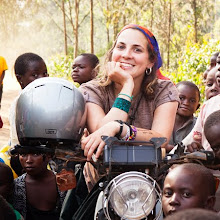
After one full year, my time with the Crosiers is up. I'm grateful for my year with them, but being an outsider in the religious life is no walk in the park, for either sides I'm sure. In the end, I'm ready for a change and the military observers have an open room for a few days. There are three of us living in the house, on a hill, over-looking all of Butembo. I have a perfect view of my favorite stretch of mountains, which looks like a pregnant woman sleeping, or dead, beneath a heavy sheet of land.
Moving only takes a day so the COPERMA team and I are able to stay on schedule. We go back out to Butu. village to follow up with M., N., and K., and hopefully to speak with their parents. When we arrive at the dirt expanse perched atop a table of a mountain, neither of the girls nor their parents are around. Only a few scraggly but energetic children bounce around in the dirt amidst four or five elderly women. The women all smile and shake my hand enthusiastically while the children hide behind their mothers legs, and two babies cry at the sight of my strange skin.
-Here, you can rest in here if you please, says a thin, middle-aged man with yellowing eyes and a kind smile.
He leads us into a small hut made of mud and sticks. There are two small wooden benches inside and the only light enters with us through the small doorway. I sit down next to the man and my colleague Urbain follows us in.
-I'm calling the survivors, says Urbain pulling out his cellphone.
The man with the yellow eyes steps back outside. I sit as Urbain discusses through the phone that the girls will be coming in two hours. School isn't out yet. I lean back against the wooden bench and take out my book. Before I can read even two pages, the man with the yellow eyes steps back in followed by five young girls.
-These are the cousins and daughters of COPERMA members in this community, he says waving at the girls.
I look to Urbain for clarification of why they're here.
-They can't go to their fields in Graben anymore. They know girls who have been raped by the soldiers there and so when their parents ask them to go to their fields now they refuse. They're very afraid.
-Oh, okay... I hesitate. What do you think I should say to them?
The girls have all piled onto the small bench across from me and are staring at me expectantly. I don't like stepping out of the realm of sexual violence or obvious physical illness because I never know what to say or how to help. Everybody needs money, clothing, vocational training, food, cultivation, tools, animals, school fees, and books. You have to focus your efforts here otherwise you'd get caught in the current of needs and never move forward.
-They want to tell you about their needs, cuts in the yellow eyed man.
-Okay.
I sigh, take out my notebook, poise my pen and look to the girls. A tall girl wearing a stained black and white striped shirt begins speaking.
-I don't have a job. None of us are in school. We left in first year because of money. I want to learn sewing.
I write down what she says and feel the weight of their false hope drop down on me. People see white skin and they see hope through money; money that's already been allocated for other survivors or being used to build the tin on the school's roof. All of the girls want a sewing machine and want to learn how to sew, except for the last girl who wants to learn to make bread.
-I can't promise you anything but I will try, I say when each girl has had a turn.
-If you can help us, really, please, says the first girl who spoke. We used to have fields but now we're afraid to go. We need something during the stand-by period.
All of their fields are in graben, where governmental and Ugandan rebel soldiers have been raping women working in their fields.
-I'll try, alongside of COPERMA, I say again. But I can't give you any promises.
The girls all get up quietly and file out of the hut.
-The girls are really afraid, Urbain says next to me.
-I know, and they have reason to be afraid.
Urbain sighs and stands up.
-I'm going to go greet a Maman just outside.
I lean back again and open my book, thankful to be able to wait alone.
-We can share this little nothing we have with you, says the yellow eyed man entering the hut.
He places a silver bowl of passion fruit on the wooden table in front of me.
-Thank you that is very kind.
-A house with no visitors is not blessed, he says as he sits down. We made beans for you last week because we thought you were coming but then you did not come. We regretted it very much. Regretted it very much.
-I'm sorry, I didn't know you did that. Thank you.
-So, what are you going to do about the stress on the educators?
He switches the subject quickly.
-You're a teacher?
-Yes, without anything. I have been working at the school for six months and I have been paid nothing.
-Who is supposed to pay you?
-The parents of the children, but the parents are poor and they are stubborn. But I can't leave because I feel bad for the children. I can't just leave the children. We ask for $3.50 each trimester but then the children will show up with only .50 cents. I have fear for my family too.
He leans back and focuses his yellowed eyes on the floor. He looks so sad, so tired, so completely used up.
-I'm sorry. I can talk with Maman Marie to see if we can try and help you too, but I can't promise you anything. President Kabila said he would pay part of the school fees for all of the children, have you not received that money?
-No, nothing, he says looking back at me.
He looks at me as if I've promised him something monumental and then showed up empty handed. They should change humanitarian to never-ending disappointment.
-And we also need a cellphone. We could communicate with COPERMA if we could have a cellphone and then we could have everything ready for you when you get here. And we also need a ball for the kids to play with. There is an inter-school football tournament but none of the kids can play because we don't even have a ball.
I look down at my notebook and recognize a rare opportunity.
-I can promise you a ball! That, at least, I can get.
The teacher stands up so suddenly I almost drop my notebook.
-Thank you! Thank you! Aiiiyyyyy!!!
He runs outside and speaks in Kinande to the small clump of children and women sitting outside. Through the mud walls I hear the children start shrieking and the man and the women clapping. He runs back into the hut and yells thank you at me several more times.
-Okay! There are others who want to speak with you, let me go and get them!
He runs out of the hut again before I can stop him.
-This is the head of the girl-mothers, he says returning with a young woman. I'll leave you alone so you can speak with her.
The young woman is wearing a pink dress and carrying a sleeping baby on her back.
-Hi, what's your name?
-Masika
-And you are a girl-mother? What does that mean?
COPERMA typically uses girl-mother to refer to young victims of sexual violence, but it's often used for any young mother.
-It's someone who has a baby without a husband, she says.
She speaks French fluently and confidently.
-So it was consensual sex yes?
-Yes, it was consensual.
She smiles a little but doesn't blush as much as most girls at the words consensual or sex.
-He said he would marry me in order to profit in that way. When I realized I was pregnant he fled immediately. Even now he doesn't know the figure of his child.
-How old are you?
-I'm 23 years old.
-I'm 24! I exclaim and smile at her.
-You're still very young.
-Yes, you are too!
-No, her smile drops from her face. I've already become old because of difficulties.
I stop smiling as well. I can't think of anything to say in response. She looks young, but somehow I realize I feel like a child in the presence of a wise adult.
-I'm a teacher at another school in Butu. she continues.
-Do you make enough to support the baby?
-No, she snorts. I want to leave but I feel bad for the kids. I can't leave the students. I don't get paid anything, I sacrifice myself. And the other teacher already fled because there is no payment.
We talk about birth control and the importance of family planning. She laughs with a tinge of cynicism when I reference how expensive a baby is. She knows much better than I do. She says there are condoms you can buy in the village but there aren't any men you can trust. She wants to learn how to sew as well.
After Masika leaves the hut I try to follow her out but an elderly woman herds me back into the hut with surprising force. Five other women flow in behind her. They don't speak French so after a few greetings in Kinande they call Urbain back into the hut. They represent the female cultivators in Butu. They need hoes and seeds so they can cultivate enough to pay school fees. Somehow my feeling of being a false promise has disappeared. Simply having someone listen to their grievances seems to be helping.
The women finish and a man older than the land itself walks in. His feet look like the stone we're sitting on; his irises are light brown and distinctly different from the black of his pupils. Many people here have irises that blend in a hazy darkness into their pupils, making eyes that can sometimes look dead. The sun and vitamin deficiencies also turn the whites of people's eyes into the color of coffee spilled and dried on paper. But this man's eyes are somehow sharp and clear.
-He needs tomato seeds, Urbain translates. He is representing male cultivators here.
The man's voice is low and smooth like it is the wind itself and has always been a part of this world.
He finishes quickly, his words are to the point. Finally, the three survivors arrive but their parents are still working in the field. They're the first ones who don't really want to talk to me. They remind me that their parents aren't paying their school fees anymore and I add it to the list of needs from the day. After over two hours of talking to the various villagers, I only spend about four minutes with M., N., and K even though they emenate the most sadness.
But when they're walking away from the hut, all three turn to say good bye and the beauty of their smiles is what leaves Butu. with me at the end of the day; alongside one definite promise, and a lot of "i'll try."
Tuesday, May 10, 2011


Friday, May 6, 2011
Recent Post, Guest Blog
Please check out my most recent post, Notes from a Young American in Congo: The Stigma of Rape, for Nicholas D. Kristof of The New York Times.
Sunday, May 1, 2011
Understanding
I don't need to see it to believe it, but when Baloti, the head of the Association of Women Living Alone asked me to come to his club to see the work of sex workers, I hoped it would at least help me understand. COPERMA has been in a psychosocial training session for the past week, so I've spent my days wandering around Musienene reacquainting myself with the place. And reacquainting myself with myself.
Anytime I'm around people I care about, people whose presence allows me to relax for a moment in who I am, the adjustment back to being alone is a sharp one. In a way it's like being pushed off of a cliff into freezing ocean. I have to adjust and remind myself that I'm a good swimmer. Being alone isn't the problem. In fact, once I'm used to the boundaries around me once again it feels good. It becomes cool, slow and soft-spoken, like the first day of fall over and over again. But at first it's sharp and disarming.
After a week of readjusting, I go to Butembo in the evening to meet up with Baloti. It's my first time moving around Butembo at night without Dusan's protective presence but security has been surprisingly good lately. Kabila has dispatched supplies, support, and Chinese managers to start building the roads. Inspire confidence just before the election, and hopefully people will forget about all your other years of failure.
Baloti meets me ouside of the club. Outside, the neon lights make the dirt road and the night metallic.
-Amy, bienvenue, he says and reaches out to shake my hand. I'm so glad you could make it come on in.
Baloti leads me to a blue metal gate with a crowd of teenagers and motortaxi drivers hovering outide.
-Look, here is our security man.
He points to a dirty looking man in a tattered FaRDC uniform, holding an AK-47 across his lap. I nod to the man and follow Baloti through the metal doors. Inside, the club is outside. There are no ceilings only walls and a large gazebo in the center of a concrete courtyard. African music is pumping with the metallic lights and people inside the gazebo. Baloti leads me to the back of the courtyard where a very average looking man stands up and greets me.
-This is a major in the FaRDC, he also provides security.
-I am so happy to see you here and do not worry I will ensure that you will be kept safe all night long.
The man continues shaking my hand eagerly and says the
words with an over-zealous seriousness clearly fueled by one too many.
-Thank you sir, I really appreciate that.
It used to bother me, making nice with people I perceive to be the devil, but my anger at individuals won't accomplish anything. Baloti and I walk to the other side of the gazebo and sit down at a plastic table.
-Let me get you a beer, Baloti shouts above the music.
-Sure thanks, let me get you one too.
Baloti laughs and wanders off to find a server. From my chair I can just see over a low wall separating the gazebo dance floor from the rest of the courtyard. Everyone looks normal to me. Young men and women dancing and periodically reaching behind them to take a swig of liquid courage, distraction, not caring.
-Hi I am so happy to see you here this makes me so happy.
I turn around in my seat and see a puffy faced man with hazy eyes and a brilliant smile reaching his hand out to me.
-This is my friend Chester, says Baloti coming up behind him. He has been here everynight to have drinks since the first day we opened.
-It's nice to meet you, I yell and shake his pudgy hand.
-But you are not nice to me, Chester says sitting down at our table. You only came as one. I want to see two muzungus.
Baloti laughs and points out that Chester is highly intoxicated. Chester leans back and wags his finger at me.
-So, every woman in here is a prostitute, says Baloti cutting to the chase.
-All of them? Are you sure?
-Yes I'm sure. Look, do you see those two girls by the door?
I follow his finger to two chubby girls standing with a couple of tall John Does. They're on their way out.
-Those girls are almost definitely minors, but they don't look young enough for us to actually refuse them. They came here about an hour ago alone to look for men for the night, and now they've found them and so they're leaving.
-And they're doing it for money? Not just dating or something?
-No, these girls are all a part of the Association. They have kids to feed or they don't have parents so they have to do it themselves. Look, all of those girls dancing are simply trying to find some money tonight.
I look back into the gazebo. I watch girls no older than me pairing off with dancing partners, sometimes getting close sometimes not. There's a beautiful girl standing in the center of the gazebo dancing in a haph-hazard way. Her hair is pulled into a small pony-tail but the front pieces are shooting into the air like the top of a pineapple. Her face is beautiful, Rwandan, and familiar.
-Oh my god, I know that woman.
-Who?
-The one right there, I point into the crowd. The skinny one who's very beautiful, wearing the blue gown with no back to it. Where do I know her from?
The woman's face reminds me of the prostitute I met in Beni who copped a feel and passed out on a couch curled around me. She looked Rwandan too, but it's not quite right. Suddenly, it hits me and it hurts.
-I know her from CEPIMA. Do you know what CEPIMA is?
-Yeah, I know.
Baloti looks down at the table. The young woman in the sparkling gown is Tatu, a girl I met when I was following up on a woman staying at the mental health center, CEPIMA. Tatu was almost entirely wiped out on thorazine and several other psychotropics but her personality battled the medication bravely. She would jump from staring blankly at a cardboard soap box with her mouth hanging open, to slowly but forcefully challenging me to a fight.
-She's in here often. She has many men who pay for her.
I watch her dance in the center of the metallic lights. Her dress is sequined and catches the different colored lights before throwing them back at the room. In another lifetime, I think we would have been great friends, I remember thinking when I first met Tatu.
-I'm going to buy you a beer too! Exclaims Chester suddenly. But only on the one condition that the next time you come you will bring me another muzungu.
-Alright fine Chester, I'll bring you another muzungu, I exclaim laughing.
-Does he ever go home with prostitutes? I ask Baloti when Chester is gazing into the dancing crowd.
-No, never. He just comes in here and drinks and looks for company. He's really a good guy. But look, do you see that girl? She found a customer and now she's leaving. And those three girls just got here and they'll leave as soon as they find customers.
He points around the room at various women of various ages. I follow his finger around the room before settling once again on Tatu. She's dancing with a man. He is running his hands up and down her bare shoulder blades and she's swaying next to his body but looking off at some spot on the floor. She's not smiling or laughing. She doesn't even seem to notice the man stroking her skin and watching her body sway.
-Amy I also sent you an email today with a picture of the Association woman who was killed recently.
-You already sent me that photo.
-No this is a picture of her after she was dead. With all of her injuries.
I snap from Tatu to Baloti.
-You sent me a picture of that? Why?
-Because I thought you would want to see it so you can understand what happened.
-Oh, okay well, thanks I guess.
I've seen those kinds of pictures before in Congo. There's no censoring or individual privacy here. But maybe Baloti's right, maybe seeing it will help me understand. Tatu suddenly walks around the outside of the gazebo in the direction of the bathroom. I stand up and start moving into her path but she doesn't seem to notice me. She walks and stares a little in front of herself as if she's blind but knows the route.
-Tatu, hi. Do you remember me?
My voice brings her back from whatever thought she was or wasn't having.
-Yes, I remember you. From CEPIMA.
Her voice is soft and sad and heart-breaking.
-Are you still staying at CEPIMA?
-No, I'm not anymore.
-How is everything?
-It's good. I'm good.
She moves her gaze around as she says it and I feel like I'm making her uncomfortable. I hope she knows I'm not judging her, or pitying her. I just hope she has happiness in her life.
-Do you know COPERMA? They have an office near here.
-Yeah, I do know COPERMA.
Her eyes focus a little and compete with her dress for a brief moment.
-Well, I work with them. If you ever need anything, go there and ask for me and I'll see if I can help.
-Okay. I will.
-Take care.
I want to do more but I don't even know where to start.
-Merci.
She effortlessly slides her hand from mine and disappears into the darkness of one of the bathrooms. I stay and chat with Chester and Baloti about nothing at all for another 40 minutes or so. Tatu resurfaces in the gazebo and sways around throwing metallic lights around the room. When I get home the next day I check my e-mail and see the picture. The woman is helpless; her eyes are open but she's no longer behind them. Only the cruelty of the jealous boyfriends who killed her is present, it soaks the photo. I realize that Baloti wasn't right and neither was I; seeing only takes me farther away from understanding.
Wednesday, April 20, 2011
Reposting
All posts relating to Maison L'Espoire orphanage have been reposted. Posts were temporarily removed as a result of adoptions currently being processed from Maison L'Espoire. Authorities in Kinshasa have begun investigations into the sexual violence and maltreatment of the orphaned children at Maison L'Espoire. As the orphanage may likely be shut down and the children moved to Congolese families, when possible, or non-abusuive orphanages, if you or your organization have any information about adoptions currently being processed, please contact me at amy.ernst114@gmail.com.
Tuesday, April 19, 2011
Rules
On a Sunday morning, as with every morning, I’m woken up by the beauty of this place. It’s my morning coffee, a kick to the heart and mind. Aside from the soldiers, the war, the suffering, this place is a paradise. The Crosier compound where I live is a small brick house, a little wooden cabin, and a gravel river running between them. The rock river is always filled with chickens, goats, and at night, a little skinny dog named Kirikou.
I stay in the little wooden cabin, often with visiting priests and brothers from the other Crosier locations. I’m comfortable, and welcome.
-Amy, bonjour! Exclaims Anaclet, one of the two cooks.
Anaclet is one of my allies here in the confused, accidental war of cultures. Even though I’ve been here a year, I still don’t always follow the rules. It’s easy for me to offend people, simply by not saying thank you when I’m complimented on my spare tire. Anaclet keeps an eye out for me and lets me know when I’m not staying in line.
-Amy, my wife would like to know why you haven’t visited the new baby yet?
Anaclet and I went to visit his wife a few days ago, just after she gave birth. Her hospital room was empty when we arrived and I quickly realized it was because we arrived literally, just after she gave birth. After a few minutes a young girl walked in holding a bundle of blankets, filled with almost white skin, a squinched little face, and a beating heart. Anaclet walked over to the bundle and fit his large dark finger into the soft skinned hand stretching it’s wings. He smiled, but didn’t verify the five fingers and toes on all appendages like I expected.
Immediately behind the baby, Maman Diem waddled in. She smiled at me as she walked in, but quickly turned her attention to trying to find a comfortable way to exist in the world. She walked over to the small cot we had just put sheets on and began to slowly climb on before changing her mind and trying a chair. Nothing looked bearable, even standing. After only a few seconds, she said something to the young girl in Kinande and they both walked out.
-She’s going to wash up first, Anaclet said turning to me.
He was absolutely beaming; his handsome face and white smile competing with each other to show the most emotion.
-Anaclet, I don’t think I should be here right now. I’m sure she wants to rest.
His face turned down the volume a little bit and he nodded.
-You’re probably right.
We headed quickly back through the open courtyards of the large hospital. Women and men were sitting everywhere, braiding hair, chatting, staring at me.
-So is it a boy or a girl? I asked smiling at him as we walked.
-It’s a boy.
-Well, that’s good. You were hoping for a girl though, right?
-Yeah, I really wanted a girl, but a boy is a wonderful gift as well!
-Yeah, of course.
Anaclet was still beaming, but I caught a flicker of hesitation in his happiness. On the Sunday when he chastises me about not visiting the new baby again, his face is back to light bulb status.
-You have to visit Amy, he says. We named her Aimé!
-You what? Wait, her? You named her?
-It’s a girl!! He yells, and laughs. They just told me it was a boy because they wanted to see what I would do. They knew how much I wanted a little girl.
-Congratulations, I exclaim!
I want to hug him, but I learned a long time ago that hugging is not appropriate in Congo. I swing my arm around and grasp his hand in a half high five, half handshake.
-That’s so exciting. Seriously, congratulations en touts cas!
-We named her Aimé!
-Anaclet that’s, I pause. That’s great.
Aimé is my name in French and what most people in Congo call me. Anaclet told me previously he was planning on naming the baby Aime. He never specified he was naming her after me, but the implication is obvious. I honestly don’t know what to say in response. Are there responsibilities with this? Am I supposed to do something? I feel more than honored, but I still don’t fully know the rules and my referee is now the one testing me.
-Well, I’d love to visit her today, if possible. I just wanted to give her some time to rest. Do you think she’s up for it?
-Of course! She’s always up for it. She was expecting you earlier.
I don’t know how I could have come much earlier than fresh off the delivery chair, but I let that go.
-Well, let’s go after lunch when you have your break.
Anaclet doesn’t respond he just walks off with a glow around his face.
While I wait for Anaclet, I call Maman Lydie to check on Lawrence, the orphaned boy who I had trouble getting out of Maison L’Espoire. The authorities in Kinshasa are still doing investigations at Maison L’Espoire, to verify the sexual violence and the dirty money; but Lawrence, at least is out. Maman Lydie is excited to hear from me.
-Amy! We are doing so well, how are you?
-I’m great, I say, standing behind the barn in the one spot where I get service in Musienene. How is Lawrence?
-He was accepted into third year of primary school, but we’re hoping to move him up to fourth year early.
Third year of primary school for a twelve year old is way behind. Lawrence is an intelligent kid though and seemed eager to go back to school so I have no doubt he’ll progress.
-He got so fat Amy! You should see him. We call him Matata now, which means Maman’s Fat Baby!
I laugh and finally understand the compliment. Lawrence is healthy and happy.
-He plays now and jokes all the time, she continues. He’s very open with the other kids now too.
-I’m so glad to hear that.
I explain how I’m doing to Maman Lydie before saying good bye. I leave the barn area glowing almost as brightly as Anaclet. An hour later, Anaclet and I set off on my motorcycle. He takes me down tiny dirt paths in Musienene, through palm trees and past groups of children. He greets almost everyone on the various paths, until we reach his home. It’s a house like any other house here, although Anaclet’s home is made out of brick. There is a mud kitchen next to the main house. The main house consists of three American bathroom sized rooms and a small entryway.
-Wahay, I say to Anaclet's wife, a young woman with high cheekbones sitting on a wooden chair.
-Iyahay! She exclaims and laughs over the bundle of blankets in her lap.
Maman Diem doesn’t speak French, but she immediately stands up and hands me the little girl. I sit down with the warm, breathing bundle in my lap and stare at the tiny sleeping face. Anaclet sits next to me, still glowing.
-She’s perfect, I say to Maman Diem.
She nods at me. Three women older than anyone I’ve ever seen before, walk in and start laughing. One of the women, with only two or three teeth remaining, begins poking me lightly in the shoulder and pointing to the baby.
-What’s she saying? I ask Anaclet.
-She says you are holding the baby, it is good.
Anaclet pulls out the several beers from my backpack that we bought in the market. He hands them out to the various people, including his wife.
-But don’t forget the baby, he says, laughing.
As if on cue little Aime starts jerking her arms and gearing up to cry.
Maman Diem opens the beer first, takes a long drag, and then reaches out for the massive bundle. I often notice the 6 inches of blanket around babies here. I can’t imagine they’re not being stifled by the heat, but they also seem to sleep more soundly than the American babies I know.
I hand Aime to her mother.
-Kuti! Exclaims the old woman who was poking me.
I look behind me and see the three women sitting in the small entryway, just behind where I’m sitting.
-Iyahay, I respond.
-Wamasivha.
-Inga!
-Unaiyo!
-Eeeehh.
Everyone in the room explodes in the usual laughter. This is a test I have passed many times before and it is instant access to laughter and smiles. The woman points at me and says something quickly in Kinande.
-She says your parents did a good job making you! Anaclet translates.
-I’ll tell them that, they’ll love it, I say laughing.
Anaclet’s older brother and two friends enter the tiny room. Every person in the room has to move so they can get to one of the open seats. More beers are opened and the chatter continues switching between Kinande, Swahili and French. Maman Diem looks tired but is laughing as often as the rest, usually at things I do or say. She wraps Aimé effectively and hands her to me again.
-Oh, thank you, I say beaming.
The whole room laughs some more.
-She said thank you! To hold the baby! Maman Diem exclaims in Swahili I understand.
I get the impression that the fifth child is a little less coddled than the first might have been. I stay with little Aimé in my arms for another 20 minutes while Maman Diem moves around outside getting dinner ready for her family. The point of this gathering is simply to share life; I didn't need to worry about rules. Their house consists of 4 small benches, a wooden table, several posters of Priests and African Leaders, two wooden beds and a wooden door. There is more love and laughter in this tiny amount of space, than anywhere I’ve been in a long while. Some might call it poverty; I think Anaclet's family and friends would call it struggle and happiness.
Wednesday, April 13, 2011
A Message from Maman Marie
PLEASE BE ADVISED: THE FOLLOWING BLOG CONTAINS POTENTIALLY DISTURBING GRAPHIC CONTENT RELATING TO SEXUAL VIOLENCE.
I only spent one night in Musienene before heading out of the country on a long-planned trip. I met up with a family member and relaxed on the solid ground she always provides. After picking me up at the Beni airport and filling me in on events, Hangie also met me at the airport the next morning for my departure. I was able to give him a decent lump of money, transferred by the Crosiers and donated by many generous Internationals who have heard about COPERMA.
Two weeks later, when I arrive at the COPERMA office, giddy with the feeling of being at home, the place is bustling. The main room is packed with large wooden rabbit cages and in the corner is a large white bag tied to a curtain, holding seven of the soft little meals. Everyone greets me with as much enthusiasm as I feel jumping around inside of my own chest. It’s been almost two months since I’ve seen all of them.
-Oh we didn’t know you’d be getting back to today! Exclaims Maman Marie, pulling me into a bear hug complete with three taps of the forehead.
-I know, sorry my schedule has been kind of crazy, but I’m so happy to be back!
Adorable little Helen hugs me as well, and Urbain, Sylvain and Hangie all flow out of the red COPERMA gate to enthusiastically greet me.
-You got fatter! Says Urbain, smiling.
-Yeah, I know. It was vacation, that always happens.
The proper response here is actually, thank you, but I can never quite fully extricate myself from my Western up-bringing. The comments no longer bother me, though. Hangie immediately pulls up a wooden chair for me and insists that I sit down.
-Where are the rabbit cages going? I ask the general room.
Maman Marie is still in charge of this operation and nobody even tries to answer but her.
-They’re going out to Kavingu today. The rabbits out there are making lots of babies so we have to give them more houses.
-And you bought more rabbits too!
-Yes, they’ll be going out today as well. Helen and I just got back from a hotel around the corner where we paid for the eleven survivors who are here to be treated at FEPSI.
-Eleven survivors? I ask, stunned. That’s the most we’ve ever brought in at once.
-They are from near Isale, where I told you 25 women were raped, cuts in Hangie. Urbain is staying with them and helping them with food and the laboratory process.
I look around and realize Urbain has already slipped out.
-Here is the information, says Maman Marie stretching her arm out to hand me a light green paper notebook.
Maman Marie looks so beautiful. Her face is a little rounder, but I’m also not comfortable enough to compliment anyone by telling them they’re nice and fat. He hair is braided back and held in a pony tail by a turquoise head scarf and she’s wearing the typical African print pagne that every woman in Congo wears, except me.
I look down at the book and flip through five pages filled with scribbles. The writing is hard to read but I can make out that there are names, numbers of rapists, locations, and consequences written down.
-Thanks, I’ll look through this. But I’d like to go to FEPSI and just greet the woman.
I always want to meet the survivors. The egocentric aspect of my humanity makes me feel as if having them in my sight will mean they’ll be okay. As long as I can see them, I feel like I can protect them. It doesn’t make a lot of sense but I don’t typically question it.
-A bientot, I say waving to everyone and walking out the door.
It’s hotter than normal for a Butembo day but the air is light and dry, not overwhelming. When I get to FEPSI I’m immediately greeted by one of the many nurses there. He tells me Urbain went to get food for the survivors, but I can still greet them. Mukanda, the short and smiley nurse, takes my hand and leads me down one of the dark hallways. It opens into an open-air room with plenty of light and about 18 women sitting on white wooden benches.
-They’re watching a video, to help them feel better about what they’ve been through. It helps with the process of detraumatization.
-Wahay, I say.
Most of the women respond but only some of them smile or laugh. The half-walls of the open room, the floor, and the benches are all painted white but the room is not lacking in color. Every woman is wearing vibrantly patterned pagne. The yellow, orange, green, blue, turquoise, and scarlet of their clothing turns the room into a garden. The color is balanced out by the darkness behind some of the women’s eyes. One woman in particular, in the center of the room, is nursing a baby and dancing with her eyes. She doesn’t smile and I recognize the dancing eyes as not knowing how to rest her gaze.
Mukanda grabs the remote for the television and suddenly the room is filled with the thunder of English. Some of the women yell at him and laugh. The woman in the center of the room continues to shift only her eyes.
-I have some work to do at the COPERMA office, I say to Mukanda. I’ll see you soon though, I’ll be back either today or tomorrow.
He waves at me with the remote and smiles before returning his attention to the blaring television. Back at the COPERMA office I sit down with my notebook and the scribbled stories Maman Marie handed me. Urbain did the interviews and his handwriting is difficult but not impossible to read.
Name: Kyakyimua K.
Age: 45 years
Event: Trapped and raped by one military in her field. Military stole her animals and everything else she had with her.
Current State: When she thinks about what happened, she has doubt about living.
Name: Kahambu M.
Age: 24 years
Event: She was raped and they stole her clothing. She was pregnant after first rape, baby was 1 year old and 3 months.
The words after this are confusing, not because of the hand-writing or the French. For some reason, I feel the need to verify. What I’m reading can’t be right. Urbain has recently gotten back from FEPSI. I jump out of my chair quickly, interrupting Hangie in a sentence I wasn’t listening to. Urbain is standing against the concrete wall surrounding the office, looking into the dirt street.
-Urbain, can you help me read this please? I don’t think I’m understanding it correctly.
He leans his head down without moving his body and reads the paragraph I’m pointing to.
-She was raped by three soldiers the first time, and became pregnant. The last time she was raped by four soldiers.
-She was raped twice? By a total of seven soldiers?
What he’s saying is clear and I realize my repetition is pointless.
-Yes, he responds and looks at the ground.
-And what about this, what does it say here, for “current state?”
He looks back at the notebook and takes his hand out of his pocket to follow the words with his finger.
-Current State: She is afraid of all men, especially military. She hurts badly, because the soldiers who raped her the second time, killed the baby she had after the first rapes.
-She had a baby from the first time she was raped, and then the second time, when other soldiers attacked her, they killed the child?
I’m still clarifying so I can wrap my head and heart around the concept, not the words.
-Yes, the baby was one year and three months old.
I sigh and go back inside.
Name: Masika M.
Age: 45 years
Event: She was raped in her field by one soldier. When she said to him, “you are my son,” he began to beat her.
Current State: She is ashamed to be around others. She feels deceived by life.
Name: Kahindo B.
Age: 29 years
Event: She was raped by one soldier in her field.
Current State: After the rape, her husband left her because he was afraid of diseases and HIV. She wants to have the opportunity to take medication so her husband will come back home.
Name: Katya K.
Age: 17 years
Event: One soldier raped her in a small house in the village.
Current State: She thinks about what happened often, when she does she always cries. She says she needs help with her emotions, and financial and medical help for her one child.
-Amy! Come and eat.
Maman Marie pulls me out of the horror in the little green notebook.
-Yeah, I’m coming, I say.
I glance over the stories again, before closing the notebook and joining Maman Marie, Hangie and Laurentine around three large metal plates of rice and black beans.
-Amy, do you have beans in your country? Asks Laurentine.
Laurentine is Maman Marie’s seeming mini-me. Laurentine is also a larger woman, much younger, but just as beautiful. She is extremely curious about where I’m from and before I came along she thought the Western world lives without food, sunlight, love, violence, poverty, black people, divorce, rape, or menstrual cycles.
-Yes, we eat beans all the time. I love beans.
-I’ve never seen you eat any beans, she retorts.
-Amy eats beans all the time, says Hangie. I’ve seen her eat beans before, I’m a witness.
I pick up a spoon, dig it into the pile of black lumps, put all of it in my mouth and then wave the spoon at Laurentine. She laughs slightly.
-Of course they eat beans, says Maman Marie eating from the same platter as me. They just don’t eat palm oil.
-That’s true. Or at least it is for my family and me. And definitely we don’t eat it like you, you all drink it like it’s water.
Everyone laughs and nods in agreement.
-Food isn’t food without palm oil, says Hangie.
-Have you finished with the reports from the survivors? Maman Marie asks, changing the subject.
-Yes, I have. It’s so great that you brought them all to FEPSI.
-One of the girls was trembling so hard yesterday. And another told me she had a wound, but that she would treat it by sitting in cold water and she would be fine.
-Where was her wound?
-On the level of her sex. When I heard that I knew that we could lose her if we didn’t help her.
-Well, now she can get it treated. And when I was there, they seemed a little bit calm. Some of them were even laughing and smiling. So, hopefully they’re already feeling better.
-You have done a great thing, Amy.
-Me? I haven’t even been in the country, you guys are doing everything.
-Yeah but without the finances we couldn’t have helped any of them.
-Well, for that you should thank the people who donated their own money to help, I say.
She nods her head and takes another scoop of beans.
-That’s true. If I could thank every one of them, I would.
Tuesday, April 12, 2011
The Mountains
PLEASE BE ADVISED: THE FOLLOWING POST CONTAINS POTENTIALLY DISTURBING GRAPHIC CONTENT RELATING TO SEXUAL VIOLENCE.
When I step off the plane in Eastern Congo, every pore in my body opens up to breathe and the fist choking my heart disappears with a single inhale. Hangie picks me up from the Beni airport in a small compact car with a handsome but pimply young driver. I almost cry when I see him, standing in perfectly pressed pants and a big grin. I swim in the clarity of the mountains.
Business picks up again as soon as I get into the car. I take out my notebook and Hangie begins recounting the things I’ve missed.
-I told you about the little girl who was raped, he says , twisting awkwardly to look at me from the front seat. She was four years old and had to go to the hospital due to vomiting. She was vomiting so much, Amy.
-Okay, Hangie. I don’t need to know all of the details, I say quickly before he can continue.
I write his words as he speaks. Hangie told me about this little girl when I was in Kinshasa still. I couldn’t get the image he portrayed out of my mind.
-What?
The young driver interrupts.
-Somebody did what to a four year old?
-A man of 24 years raped her on the level of the mouth.
-Was he a crazy person?
-No, he was normal.
The taxi driver tsks loudly and shakes his head as I sit silently in the back watching their exchange. So many people in this region are used to the stories. Although people continue their lives as best as they can and don’t discuss or dwell on suffering, they’ve all heard the stories before. I like watching anger flare up in response, especially in men. Something about it is soothing to me.
-What else has happened that I should know about?
-Vraiment, Amy, security is not good right now.
-What’s happening?
-Isale is suffering again from the military fighting. A girl under 18 years was raped by a man over 40. They trapped him and attacked the rapist with a machete, he was in the hospital for a while.
-Is he still in the hospital? Can I speak with him?
I haven’t yet gotten to speak at length with someone who can’t deny what they’ve done. I don't know what I would ask but something inside me is aching to try, and foolishly hoping it would help me understand.
-No,he died.
Hangie looks out the front window now as he speaks.
-Where was he hit with the machete?
-In the chest and on the neck.
I don’t know how I feel about this. I catch myself feeling happy that the man lost his life. I don’t know that my heart has room anymore to care for the perpetrators as well. I don’t feel guilty for feeling a twinge of happiness, but the happiness does make me sad.
- Seven people were attacked and killed near Beni. A man in Kipese was killed by FaRDC. Eleven women are in Butembo right now being treated at FEPSI. They were all raped just past Isale. There were 25 survivors of rape by governmental soldiers and Ugandan rebel NALU soldiers.
He lists the suffering like he’s reading me a grocery list.
-You’re talking about people actually being raped? Asks the driver, suddenly.
-Yes, that’s the line of work we are in, Hangie responds immediately.
-What is happening to the world? The driver shakes his head and tsks some more.
-But wait, how was Kinshasa? It’s been so long since we have seen you! Hangie exclaims suddenly, twisting again in his seat.
-I know, believe me it wasn’t because I didn’t want to come home to North Kivu. Kinshasa was…. I pause. Kinshasa was scary.
Kinshasa feels like a hangover. It feels like a poison that’s mostly gone but I’m still recovering. It makes me uncomfortable to think about and with a little distance, I realize it’s because of me, not Kinshasa. I didn’t trust anyone. Maybe it was founded, maybe it wasn’t. People everywhere warned me about everyone else. In the East I often forget to close my bag or leave too much money with a vendor. I’ve always been comforted by strangers who poke me and tell me to zip my bag or chase me down the dirt road with 20 cents in their hand. In Kinshasa I didn’t even give them the chance. I glared at anyone who walked in my direction or stood too close, and I clutched my bag to my chest like it was a dying baby. Yes I had some reason; there are shegue who hit people with machetes without warning and police officers who will rob you before protect you. But there were also taxi drivers like Jean-Louise who talked about missing his deceased wife and was concerned if I didn’t seem excited about what I ate for lunch. There were people like Sister June, Maman Lydie and Maman Christine, who saw only the gravity of suffering children.
Kinshasa was like an apple with a toothpick embedded somewhere inside; I feared the whole city. It’s dehumanizing to look at every person and assume they’re a snake. And normally it’s the assumption that proves the rule. One month in Kinshasa made me more jaded than a year in North Kivu, and it was only because I didn’t put forth the effort to brave the risk of trusting without knowing. But I'm back in the mountains now, and I've missed them like they're people.
Suddenly, a pineapple is thrust in front of my face through my open window. We’ve stopped at a curve in the road where women wearing pagne are chatting and selling their goods. About four more pineapples and a basket of strawberries pop through the window.
-Wahay, I say nervously, in Kinande.
-Iyahay, every woman responds in unison as they disintegrate into laughter.
Their laughter clinks slightly; both soft and sharp at the same time, like violets tumbling across broken glass. I welcome the laughter and join in.
Subscribe to:
Posts (Atom)


 Posts